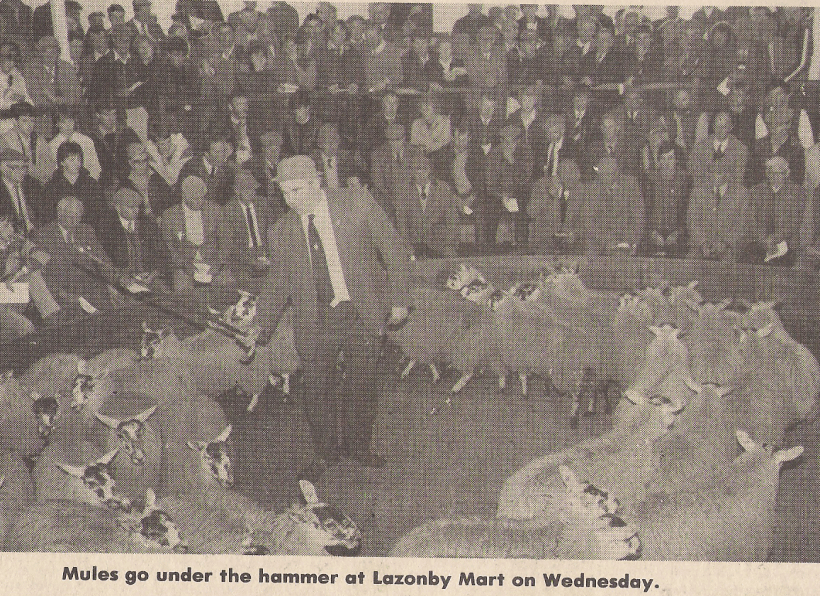
Lazonby Auction – A Young Auctioneer learning his trade.

Lazonby is a small village built upon the steep western slope above the River Eden, only a few miles east of Penrith. Most of the older houses are constructed of red sandstone hewn from local quarries generations before. The Carlisle – Settle railway runs through the village and just below the station sits Lazonby Auction Mart. The mart has stood there for over 100 years and in that time has seen little change.

Over much of its life time Lazonby Mart has for 9 months of the year been nothing more than a small weekly market, beloved by local farmers along the River Eden and on the East Fellside of the Pennines. For a brief time in the 1990’s the weekly mart flourished in the Spring months with up to 3,000 prime hoggs per week rattling through the ring. The spring months were very cold and very dark. On a freezing Wednesday morning, the prime sheep buyers would alternate between touching the backs of the sheep to assess their condition and quality, to warming their hands against the giant glowing  pad of gas heater. As the auctioneer at those sales I was standing in a tiny auctioneer’s rostrum, with room for one person only. There was no heater for me and as the sale progressed my finger ends despite the fingerless gloves became ever colder as did my toes. Even despite this, everyone loved Lazonby with pen after pen of quality hoggs flying off the old manual weighbridge and in to the ring. My colleague David “Syd” Westgarth, would be working out the weights of the sheep on a calculator and writing the information on a frozen blackboard for the buyers to see.

In the ring there the sheep buyers were drawn from all of the Northern counties including Arthur Pooley from Chorley and Bob Sumner from St Michaels on Wyre. Local buyers were Jared Faulder and Keith Ewbank and there were other visitors occasionally. The banter was good natured and trade always competitive. This weekly market worked well. After the sale we would retire to the Joiners Arms for lunch, there being little appetite to rush back to company headquarters at Penrith.

The little weekly prime market was not what Lazonby was famous for. Ask any farmer in Cumbria and probably most farmers around the country what Lazonby Mart sells and the answer would be immediate, Mule Ewe Lambs. Known as Gimmer Lambs in this part of the world. The Mule is the by- product of the Blue Faced Leicester Ram and the Swaledale Ewe. This breeding produces a strong, hardy and prolific ewe lamb much loved by lowland shepherds the country over.

There are many markets across the north of England selling the Mule gimmer lamb. Lazonby was known as “The Foremost”. Why? Well for a start it was the biggest market of its type attracting buyers the length and breadth of the Country. Secondly the quality of the sheep was in those days, second to none. The Swaledale flocks of the high Pennines produced lambs that thrived wonderfully on richer lowland pastures. The Mule sheep and Lazonby market grew several fold under the tenure of auctioneer Norman Little. For years he promoted the sheep, canvassed the producers and earned the respect of farmers as far north as the Roman Wall, across Alston Fell and throughout the Lake District.

At its peak Lazonby could comfortably handle and sell over 30,000 gimmer lambs in a single day and still be ready for business the next day to sell up to 10,000 more castrated Mule Tup Lambs or Wether’s as they are known locally. The sales campaign would start in the summer when the Lazonby team would travel the high roads and by- roads visiting mule producers on the farm, canvassing their support and hoping for their custom during the autumn sales.

The huge list of Lazonby lamb buyers would be transferred to envelopes and catalogues and sales circulars sent out in good time, telling the buyers to make a note in their diaries of the all- important sale dates. Many buyers were regulars, arriving year after year, often purchasing the same sheep from the same producers if they had thrived and done well the previous year. The sensible farmers offered some good luck penny and this was often remembered by the buyers at future sales. Farmers who scurried away after receiving their cheque from the office, without paying their respects and some good luck to the buyers would often be marked down on the catalogue and ignored the next time.

Well-seasoned auctioneers knew which buyers bought which sheep and would deliberately look or “not look” at those buyers depending on how the trade was going. “Old customer” was a phrase auctioneers loved to trot out at the fall of the hammer, meaning these lambs can be bought with confidence.

On the farms the selling process began weeks before market day, with some producers feeding a little concentrate or cake to the lambs to bring them forward after weaning. “Learned to trough” is a phrase that some buyers wanted to hear so that they did not have to spend time teaching lambs the process of eating feed from a trough at their new homes. Also these lambs will follow a farmer shaking a plastic bag to the ends of the earth if they think there is cake to be had.

Closer to auction day the lambs were wormed, injected, scratched for oarf, which is an immunisation process against the oarf disease. Then a series of dipping’s in the sheep dip trough with a final soaking in pearl dip would produce a lovely dark hue to the lamb wool. Add to that a good face- washing and fleece trimming that any professional crimper would be proud of, then the lambs would right and ready for sale. So much work and so much time spent by the shepherds for one minute in the sale ring for the auctioneer to work his magic and draw the best price possible out of the crowd. A whole seasons work from tupping time the previous autumn for less than 60 seconds in the sale ring to achieve a year’s wages from those sheep. No wonder some farmers get nervous and stressed on these days. Maybe the auctioneers do too, although the farmers would never know it!

It is mid- October. Finally sale day has arrived. A myriad of trailers and huge wagon transporters are unloading constantly at the unloading docks. Local people know and accept that the tiny back roads to Lazonby will be a constant procession of trailers and wagons, for most of the day. These days are the “harvest of the fells”, the most wonderful time of the year to most local farmers.

The sheep are taken from the docks to pens with all haste. There is a constant noise of whistles and shouts as the lambs are ushered down the alleys. Some farmers are lucky and had been balloted or drawn in the concreted top pens close to the sale ring. Others are further down the field in grass pens. The unluckiest haven’t made the first penning and can only arrive later in the day for a second penning of lambs. On the very busiest days, there is even a third penning with these lambs unable to arrive before 6pm with daylight fading fast.

Farmers aided by drovers pen- up their lambs. Often the farmers are carrying huge sacks of sawdust. Too much washing and preening has gone on to allow the lambs to get dirty. They now stand on a thick crust of dry wood shavings. Nervously the farmers scan the sky for sign of rain. Rain turns the golden fleeces in to a bedraggled tangled mess, not what anyone wants to see. Farmers with pens for the prize show diligently work away with soapy cloths to give the mottled faces of the mule gimmer lamb a final wash.

Closer to sale time, buyers begin to arrive. There are warm welcomes from the auctioneers and the farmers. Many buyers have become friends over the years. They are in time to see the judging completed. A championship has been awarded and the winning farmer is photographed with the sheep, the judges and the trophy. The trick is to look reservedly happy without beaming. These farmers are modest and the real joy of success will be shared later either at home or in the pub, depending on prices of course.

9.30am and the sale is about to commence. Norman Little is the man in charge. He is the manager of the market and has spent years building up the trade, the breed and the market. He is in his element. A tannoy message calls the buyers to the ring and quickly the narrow wooden benches around the sale ring fill up as people take a pew and settle down for the sale. Beside Norman sits Gordon Teasdale a man who left school to work at the auction and has come through the ranks. After Norman’s day, “Tizzer” will start the sales. His photographic memory ensures that he never forgets a buyers face and can recall names at will. Norman and Gordon are experienced auctioneers at the top of the game. I am lucky to be an apprentice in this arena.

The first lambs enter the ring followed immediately by the farmer and his family all armed with sticks or crooks. Norman is immediately in to his stride. His style is beautifully lilting. He knows the sheep, their value and the buyers. He knows who will buy what and within a few minutes how far they are prepared to “travel”. Norman rarely has to take more than five or six bids to get to the price. He has the complete confidence of the both buyer and seller.

In less than thirty seconds, the hammer is down. “Let them run” shouts Norman. The ring drover and young auctioneers who police the huge oak doors in to the ring are trained to get the sheep out of the ring just as the last bid is being taken. At the same time the next lot of sheep is entering the ring. The trick is to let the new sheep just catch sight of the old sheep leaving the ring. If they do see them they charge in to the ring with ease. Get this process right and the sale runs swiftly and smoothly. Get it wrong and there is a mix up and a telling off from the auctioneer.

Behind the wooden doors and all the way back to the pens there is a team of drovers each working their station to get the lambs up to the ring. They rarely change their position except for a swift break and a bite to eat. They will spend many hours just doing the same job, pen after pen. Behind the doors the final drover is often a brilliant counter of sheep. I’ve known some men be able to count the sheep in fives as they work through a large pen of sheep. This is hand/ eye coordination at its very best. Most of work in two’s as we count. The sheep are counted in and counted out at Lazonby. Pride is taken in the job right across the chain.

From the ring the sheep are taken to the buyer’s pens by another team of drovers working as fast as they can. Some large buyers have four deck sheep transporters waiting at the docks to be loaded. At the largest sales it has been known for a wagon to be loaded with over 400 lambs and be driven down to Salisbury Plain, arriving before the auction staff have left the market at the end of the sale day. Other sheep are driven on past the field pens and in to the huge paddocks at the far end of the market. The paddocks can hold hundreds of sheep. This process is vital ensure the smooth running of the sale without any great delays. The whole droving team is working flat out to achieve this, all day and in to the night.

As every lot of sheep is back- penned, a message detailing the buyers pen and the pen number is relayed by walkie- talkie back to a trainee auctioneer in the office who compiles a list in order to make it easy for buyers to find their sheep after they have finished buying, The young auctioneer is desperate to get out of the office and back in to the buzz of the market.

All day long the auctioneers maintain their rhythm, stopping only to clear those buyers who have chosen to stand in the way of the sheep exit gate. Eventually the young auctioneer gets his turn to sell and for a couple of hours he is in a whirlwind of endless lots of sheep, trying to value them before he starts to sell them ,remember buyers names as they bid and generally not make a cock- up on his shout. Very often a senior auctioneer sits close by with a steadying word or an odd new buyer’s name.

It is late afternoon and darkness has fallen. The ring lights are on, and way down on the field pens the temporary light twinkle brightly as they dance in the evening breeze. A chill is settling in the auction ring, but the seats are still full and the lambs keep coming. The same phrases keep coming over the tannoy, “high- gone lambs”, look at the colour”, “here’s some power”. Meanwhile the drovers are working away at the same pace, never breaking stride. At the bottom of the yard the café is doing trade. Up the stairs on the loft, farmer and buyers are sharing the long tables, eating pie and peas or a selection of cold meats. The young auctioneer hopes there will be something left for him at the end of the day. He has no wife to go home to and no supper waiting. That will come rather later in life.

It’s almost 10pm. The sale has been running for 12 ½ hours non- stop. In the Joiners Arms some of the farmers who were sold in the first half an hour, have been in the pub since them. Two of them are now downing their 30th pint.

In the sale ring, all of a sudden the shout comes from behind the oak doors “last chance tonight”. In a flash the last pen of sheep for sale has entered the ring and been sold. The auctioneer, the fourth of the day, thanks everyone for their attendance and bidding. In seconds the ring seats have emptied and an eerily cold and still calm pervades the air along with the rank smell of sheep dip and soiled sawdust. A drover quickly begins to sweep the steps. He once found a tenner under the seats after a sale and has been looking out for another after every sale since.

There is a large queue of buyers in the auction office. The clerks are exhausted, white faced with the mental strain of a 12 hour shift, counting money, writing bills and taking cheques. As soon as the last buyer is accounted for they will be away.

The two youngest auctioneers scroll through the lot sheets writing the sale report and selecting the highest prices and best flock averages. Immediately after they head for the café for foo,d a warm up and plenty of banter with the lasses.

Norman Little sends a message that the auctioneers are needed to check buyer’s pens and count sheep. In the distance throughout the sheep pens there are flash lights moving backwards and forwards as buyers look for their lots. Some are even dosing their lambs before they leave. Gradually the hive of activity quietens down. Some of the full- time drovers will work through most of the night, counting, moving, loading, counting, moving loading.

Now the office is closed down and the ring- lights are turned off. Even with the big doors closed, a cold draft whistles through the gap. The ring has become cold and lonely, where just an hour or two before it was buzzing with people and lambs and the rapid fire lilt of the auctioneers. Now the sale is done and lambs will be on their way to new homes to live the rest of their lives.

The young auctioneer is dead tired but makes it to the pub for last orders. It is still heaving with a swell of farmers, still in auction gear. The mood is joyous. Trade and prices have been good all day. It is a fantastic atmosphere. Lazonby the “Foremost” mule market has done its job once again. Everyone heads for home tired, rosy cheeked and happy. Meanwhile the handful of dedicated droving staff are still there trudging through the mud of the field pens, finding lambs for anxious hauliers who want to get on the road and drive through the night.

In the morning, it will all start again, with 8,000 wether lambs to sell, because this is the back- end, the harvest of the fells and no one working at Lazonby Auction blinks an eye. This our job and our life. It’s what we know and what we love. It is also why some of us will it miss very much as we progress our careers and move on. There is always a feeling that it would be good to go back and with the knowledge gained in later years, do it all again.

Now the times have changed. There is less sheep on the hills and less buyers to purchase them. Lazonby still goes strong and always will but we never again see the days when 30,000 lambs go through the ring. Boy did we enjoy it!
Advice from Jos Naylor

I’ve met and worked with most Lake District farmers over the years. Here i recall a farm visit to Jos Naylor in the Wasdale Valley one cold January morning.

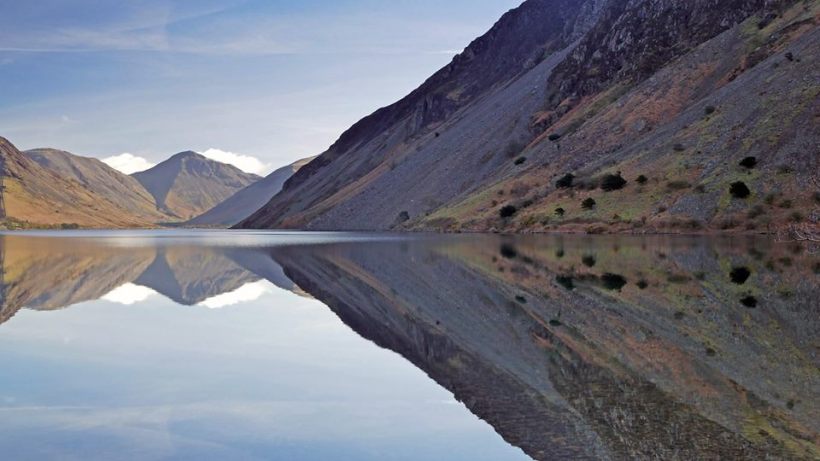
Photo taken by my friend and ex- rugby team mate Ian Mallinson.


It is a freezing cold January morning as I make my way along the narrow roads of Wasdale. This is a truly remote part of the Lake District. Only a few miles from the Irish Sea, the Valley is dominated by some of the highest fells of Lakeland. Great Gable stands magnificently at the head of the valley flanked by the Scafells to the south and the Ennerdale fells to the North. Wasdale Screes fall sharply in to Wastwater. At 258 feet deep, it is the deepest lake in Cumbria. The lake bed is actually below sea level. The geography is stunning on any day of the week. A mass of tumbling rocks and boulders, with great swathes of scree, carved out and exposed by dying glaciers at the end of the ice age. At this time of year, with the winter wind and rain howling in from the Irish Sea, it is no place for the timid.

One can but imagine the Norsemen of the 10th century clearing the valley bottom to settle and colonise. For them perhaps it was almost a taste of home. Much later William Wordsworth was to describe the valley as “long, stern and desolate”. Perhaps he was visiting on day rather like today!

The working farms up here a hard places and it takes a special type of farmer to work them, in a land where local knowledge and custom is time honoured, trusted and proven.

Beneath the highest mountains at the head of the valley sits England’s smallest church. Dedicated in modern times to St Olaf, the main church beams are reputed to be taken from a Viking longboat over 1,000 years ago. My journey will not take me that far today.

It has been snowing hard and freezing at night. There is a bitter nip in the air and the swirling eddies of bitingly cold wind, chill to the bone. My car heater is on full, as I press on up the lake side road, my tyres smashing through the icy puddles.

I am on my way to see Jos Naylor at Bowderdale Farm. Jos is a legendary character. A world champion fell runner, he was often called “The King of the Fells”. His achievements on the hills are incredible.  In 1975 one of his greatest feats was to conquer 72 Lakeland peaks, running over 100 miles ascending 38,000 feet and in a time of 23h 20m.

The Cumbrian hills are both his work place and his hobby. Passionate about this landscape, he is both proud of the sheep he breeds and the landscape they live upon. Naylor’s have worked this valley for a few generations and Jos’s son Paul is following on behind and doing a great job. These are hard, cold and wet farms on the western fringes of Lakeland. It takes special people with unique skills to thrive in this environment. The sheep bred on the hills are also hardy. If they can survive harsh winters grazing on these fells then they can certainly do well later in life when they are often sold as draft ewes to more lowland climes. In my time as a Lakeland auctioneer in the autumn months, I sell many thousands of sheep from most of the farms in the valley. These are my dog days and the sales that I will later look back on with most pride.

I arrive in to the yard, and Joss is working amongst some young Herdwick sheep he has penned up. There are snowflakes scurrying and diving around the in the air. The cold makes me catch my breath. From the boot of my car I quickly don extra layers and some fingerless gloves. Jos acknowledges me and keeps working. I’ve come to see the sheep, and I start to work with him. After a while the job is done. He is satisfied with the outcome.

Only then do I notice that on his upper body Jos is wearing nothing but a cotton checked shirt, sleeves rolled up above the elbow and unbuttoned down to the navel. He is it seems oblivious to the cold. I expect that as the snow begins to fall faster we will retire to the kitchen for a drink. Not a bit of it. Jos leans back against the sheep rails and folds is arms across his chest. He begins to question me about Cockermouth Auction. This is the late 1990’s and we are still no nearer to getting our much- hoped for market. The old town centre site is working at maximum capacity and we are selling thousands of lightweight lambs from most of the farms in Wasdale and nearly every other valley.

“You would wonder where all these little lambs go” he says. I tell him that the vast majority of the lambs are slaughtered in Britain and sent in carcass form to countries all over Europe. Thousands of little fell lambs produced by Cumbrian farmers weighing around 30kg as they are sold, end up on tables from France to Turkey. This growing market is a godsend to all hill farmers who breed such lambs in the hills that have a limited market in our country.

I crack a joke. “You know Jos, these little lambs are Cumbria’s second best export after nuclear reprocessing. Jos laughs because he has a working relationship with BNFL and the Sellafield plant is just a few miles distant from Wasdale.

By now my fingers and toes are going numb. Jos doesn’t seem to notice. He is impervious to the cold. He asks me if I am still playing rugby. I tell him that I am however at 33 years old, I’m getting towards the end of my career, and my knees are hurting more and more.

Jos looks me in the eye. “Listen lad. If you enjoy it and still want to do it. It doesn’t matter if you aren’t as good as you used to be. Just keep doing it, because there will come a day when you just can’t”………

Those words stick with me and I often think of them years down the line when I am in my forties and still lacing up my boots. I still love it and still want to do it. I do so in the knowledge that soon the day will come when “I just can’t”.

“Still running then Jos” I say though chattering teeth. “Oh aye” he replies.  “I like to get up on the tops, clears me head, and gives me time to think”.

“Not on a day like today though” I joke. “Oh yes” he says in all seriousness, “wouldn’t be a problem. You see I know these fells, every bit of them, and I know me, what I can do and what I can’t. Too many people go on to the tops and they don’t know them, and they don’t know when to get off. Then when they realise they need to get down, it is too late”!

He goes on to tell me that not too many years ago, a crack squad of Special Forces people approached him to go out for a training session on the fells. Jos says that one by one he left them for dead as they gave up and dropped out, until the last one finally could go no further. Jos had to help him back down to safety, so exhausted was the soldier. “I kept him going with boiled sweets” he said. “He thought he could break me but it “nivver” happened”.

Jos tells me that all his power is in his legs. He is remarkably tall for a fell runner, but he is stick thin in the upper body. His legs are made of steel and judging by his dress code on a freezing January day, he is impervious to pain.

He does admit though he does like to warm his bones and has rather taken to spending time in the Canary Islands where he has bought a home. The thought of being in such a place at this very moment is very appealing, at least to me.

Our meeting has come to an end and Jos is eager to get on with more sheep work. He is going out in to the fields to “look the sheep”. I bid him goodbye and by the time I remove my winter clothing in order to get back in to the car, I lose Jos in the gathering wisps of winter snow as he half walks and half runs up the in- bye land above the farm. In a minute he is gone from view. It is a good job that I am not required to go with him. I couldn’t keep up!

By the time I leave the valley, my fingers and toes are coming back to life. His words of advice stick with me for years as I carry on dragging my ageing body around the rugby pitch, loving every minute of it until at the age of forty four I am forced to retire, because finally, “I just can’t”.

Jos also heeded his own mantra. For some years later at the age 70, he successfully ran over 70 Lakeland fell tops, covering more than 50 miles and ascending more than 25,000 feet. All of this in under 21 hours. I don’t think the words “Just can’t” are in Jos Naylor’s vocabulary.

Welcome to the Lake District – Wasteland or Wonderland?

Recently a journalist from a national newspaper described the Lake District as a sheep- wrecked wasteland. It is not the first time journalists have sought to de- cry farming in Cumbria. This man has been making a habit of it having written about the need to re-wild areas like Cumbria, claiming that sheep compact the vegetation and soils on Lakeland’s fells, exacerbating surface water run- off, contributing to flooding issues, destroying flora and fauna and so on. You get the picture.

His comments were generally not well received in Cumbria. It wasn’t just farmers that bristled but also owners of tourist businesses  and I have to say some environmental bodies who work with farmers in Cumbria too and found the approach unhelpful. People who know and love our county may not be dissuaded by controversial sound bytes designed to increase the author’s profile, but to anyone reading newspapers and considering visiting Lakeland for the first time, they may well have been dismayed to read those damaging and deliberately provocative comments. Farmers maintained a dignified silence to the point where they were goaded on social media by the journalist, desperately seeking a reaction. Few bothered. The most ardent environmentalists are of course singing the praises of this re- wilding approach.

I cannot comment on those books or articles. I haven’t read them in full. I have however heard other people’s thought’s. Whilst most have found the extremes of sheep removal and re- wilding unpalatable and for some quite laughable, there was an acceptance that farm management could and should make positive contributions to protect and conserve Lakeland’s environment in future, but not at the expense of the farmers or all of their sheep!

So is our beloved Lake District a wasteland or a wonderland? 40 Million Tourist’s visit Cumbria annually spending around £2 Billion. That doesn’t sound like a wasteland to me. I’ve never met a tourist yet who doesn’t love to see sheep on the fells as they grind and sweat their way up the well- trodden paths of Lakelands finest fells. What better a back drop can you have as you sit and eat your sandwiches in the gentle summer breezes on the tops, watching the Herdwicks grazing the slopes, listening to the faraway bleat of lambs, momentarily lost from their mothers in the thick grasses and swathes of bracken?

Farmers tell me that on many fells and commons the grass sward is quite thick these days, butterflies are returning and most of the land managers I know are proud of the wildlife, birdlife and other habitats on their farms.

So what is the story? Well, it is common knowledge that in the austere years following WW2, this country and many other European countries were counting the cost of war. There were food shortages and rationing. Successive governments sought to get the country back on track. The farmer was the housewives best friend. She needed the dairy man, the shepherd, the beef farmer and the pig producer like never before. Over one third (33%) of the weekly wage was spent on food. Our farmers were respected for the fine job they did. Food was a necessity and not that readily available.

Gradually over the next few decades food austerity began to dwindle. All the while food production was in full swing. The new common market gave farmers quotas and targets, positively supporting increasing production through various measures. Add to that new technology, better farming methods and increasing yields and it did not take that many years to reach saturation- point. Crazy as it sounds we were soon over- producing. We well remember the Butter Mountains and wine lakes as excess stocks were bought and stored under what was simply called “EU intervention”!

In Cumbria during my working life our farmers were paid subsidies to keep more breeding stock via a host of support measures. There were headage payments for breeding cattle and sheep, top- up measures to ensure a guaranteed price on some prime stock at the time of slaughter and tradeable quota’s for milk production and sheep. The result in nearly all upland areas of the UK was that farmers kept more and more stock to take advantage of the subsidies. Who could blame them? I would have done it and so would most people. As a result, more sheep were kept on the fells than ever before, more cattle grazed in the valleys and more milk cows put through the dairy parlours all across the country.

The general public did not complain because food was becoming cheaper year upon year. This has continued to the point where the average food spend as percentage of earned income is now estimated to be as low as 11%, a far cry from 1950. What this means is that the consumer has far more disposable income to spend on other goodies. Food is so cheap it has become disrespected. My grandmother would scrape every last scrap of margarine from a tub. Nothing was wasted. Food would be re used or re- heated by her in the following days. Grandfather raved about three day old lamb hotpot which he claimed he would happily eat every day as the flavour matured with each re- heat. Today it is not so. Food is no longer valued by the consumer. In 2015 UK households binned over £13 billion of edible food, nearly £500 per household per year.

Out with the rubbish has gone public and political respect for farmers and also consumer knowledge about food production. It is a travesty that young people learn so little in schools about farming, food production and the environment. Indeed all the talk about farmers for many years has been the misguided myth that they are production subsidy junkies, living in high old- fashion, driving large country cars and abusing the animals they farm in search of maximum production and profit. A visit to and a chat with any lake district farmer would soon put paid to that.

Many farmers in the Lake District are very good at talking to the public. They have to be as most Lakeland farms are criss- crossed with public footpaths leading to and from the fells. My old friend and auction mart director Stan Edmondson positively revelled in meeting the stream of visitors trudging past Seathwaite farm in Borrowdale, heading for Great Gable or the Scafell’s. “Where’ve you been and what have you seen?” was a phrase that many will remember him by. In this and other respects farming is linked arm in arm with tourism, indeed perfect bed- fellows in areas like Cumbria. So much so that Cumbria Local Enterprise Partnership is currently drafting a rural growth plan linking farming and tourism tightly together.

By the late 1980’s it was clear that some of the Lakeland fells were becoming over- grazed. Solutions were offered and on some fells farmers were financially encouraged to reduce the numbers of fell ewes grazing on high during the winter months. At this time a plethora of non- governmental organisations began to grow with a very fixated view on how the environment, rivers, lakes, habitats, flora and fauna should be managed in areas like the Lake District. By the mid 1990’s production support had disappeared. European and government policy dictated that support payments to farmers should be based on environmental rules and outcomes.

At this point the relationship between the farming community, government agencies and environmentalists began to sour. Farmers were now being asked to keep even less sheep and cattle in the name of environmental protection. Blamed for the loss of habitat, over grazing, water quality and all the while being ordered by supermarkets to offer uniformity in supply, quality and conformation (remember the wonky vegetables) and at reduced or even penal prices, times suddenly got pretty difficult for farmers.

The BSE crisis of 1996 followed by the collapse in Beef prices, then a collapse in sheep prices, Foot and Mouth disease in 2001, an subsequent years when there was no export market, brought the livestock farming industry to an all- time low. Hard farming areas like the Lake District suffered as badly as any other area of the country. Many farm businesses were able to survive only with the subsidy payments available, using this money to prop up loss- making livestock enterprises. Profit almost became a dirty word in farming.

Sound business advice would have suggested that those farmers doing worst should actually cut and run, sell up and let those of the biggest size and scale swallow the smaller poorer farms. It didn’t happen. Why? Well here is the rub to all of this. Despite all of the issues and problems that have beset the farming industry over the last thirty years and more, there is one factor that remains unaccounted for and that is the human factor, farmers themselves.

Generations of farming families have worked these hills and valleys. There is pride and stoicism. It is passed from generation to generation and is bred- in, rather like the hefting gene in genuine fell sheep. In the bad times young farmers have perhaps had to take second jobs and work elsewhere but so often there is hope and expectation that one day, the farm will be theirs. The cycle will continue.

At this stage of my own career as a Lakeland auctioneer I have worked with at least three generations of family farming and my how times have changed. What does not change is the passion and the care to farm the Lake District “to the best of our ability”. I talk to many young farmers whose priority is to learn the skills peculiar to farming in their valley or on their fell. Every fell or common is different. Now they are also challenged with learning new skills, how to improve the bio- diversity on the farm, how to manage the water, how to deal with flooding. These are all part of the modern Lakeland farmer’s new challenges and working practice. The good news is that I haven’t met many farmers who are not up for the challenge. I see this a huge positive for the government, general public and all those concerned principally with conserving the environment.

So how is it going to work in the future? No one has crystal ball good enough to see through the hazy maze of Brexit, future government policy, climate change, international politics, and a world population set to increase from 7 billion to over 10 billion in the next thirty years. These are global issues we have to address. It is now clear that we have to put the past behind us and craft a land use policy in this country which achieves some very simple aims: –

  • Sustainable food production
  • Viable farming
  • Conserve and enhance our natural environments
  • Protect our fresh water supplies.
  • Farmers collaborating with farmers to achieve all of the above.

We cannot stick our head in the sand. At some stage in the next couple of decades we will go hungry in this country. We have such a reliance on cheap imported food from all over the world that it is dangerous. The reality is that food importation costs are going to rise, climate change will effect food production, pressure on fresh water supplies will increase significantly and the potential for political and religious disagreement is only going to strengthen.

As a nation we have to plan for the future. We have to get past short- term government thinking with manifestos designed only to win votes at election time. As a country we have to be bigger than that. The four aims I suggested above or not in any way exclusive. Instead they are totally linked and mutually inclusive.

In my opinion, the group of people best placed to deliver those aims are farmers. The cheapest, most cost effective way to deliver those public benefits is by supporting farm businesses. They have the skill sets and the ability with training and guidance to make this happen and achieve those aims. How do we do this?

I would be crunching the numbers to see what level of sustainable food production will be required to feed a population in the UK expected to exceed 80 Million by 2050. I’d be working with the farming community to improve productivity and efficiency under the concept of “more from less”. In other words how to grow more food with reduced inputs and costs. This means embracing new technology, improved working practices, better training and exchange of knowledge.

At the same time I would be engaging the UK leaders and experts in environmental protection. I would be asking and agreeing a set of goals and targets focusing on areas of greatest need. I would be looking to improve bio- diversity in those areas, encouraging improvements to habitat, improving our water quality and how we actually manage the land particularly in water catchments and areas of potential flooding.

All of this has to come at a public cost. Food production and environmental management is not a freebie. If you want cheap food in the shops sold at or under the cost of production, then food producers have to be subsidised. This is where reality has to kick in for supermarkets and other food processors. Environmentalists cannot expect farmers and other land managers to carry the cost of environmental protection and enhancement. Nor can they reasonably demand that their need of financial support is any greater or more important than the farmers. If the population starts to go hungry, they will forage the environment to survive. A balance is clearly required. We’re already past the “them and us” stage. They have to work in partnership.

If government buys in to the goals I suggested above, they then need to gather all parties together. All of them have their own goals and agenda’s. Through discussion and negotiation, a common set of goals and targets can be achieved. Everyone will have to settle for wins and losses, but at the end of an embryonic and totally new land management policy will be tabled and agreed to with which to go forward.

The final job will be to cost and apportion the level of public funding required to achieve the goals and targets. Again it will an inclusive subsidy regime rather than exclusive. Leading the field will be the farmers who will be tasked and supported in producing great food, cheaply and economically whilst at the same guaranteeing to conserve and where possible improve the natural environment.

This has to happen on a regional or even local basis. One size fits all national policies have not worked. Local knowledge on the ground has been ignored far too often by government people in far- away offices who have neither the knowledge nor the experience to administer agriculture and environment policies. Someone at a high level needs to grasp this fact and put their head above the parapet. DEFRA and other agencies are simply not fit for purpose in their current state.

Once the policies and goals are fixed, a public purse needs to be tapped in to in order to fund food production and environmental support. All the while the government must actively promote the new land use policies to the public. Consumers need to be educated in a number of ways. This will include the importance of all the land- use goals, British Values whereby it is no disgrace to promote “buying British” or even better “Buying local”. Incidentally British values are already supposed to be taught in Britain’s schools and colleges.

The public would then hopefully realise that once again, the farmer is a friend, perhaps in an even stronger way than 70 years ago when food production was the only goal. In the words of Bob Dylan “the times they are a- changin”. The problem as time goes on is that the changes are happening faster and faster. While politicians dither leading up to Brexit we are losing valuable time to get our agriculture industry in order and set up for the next round of challenges.

We need to be preparing the next generation of young farmers right now. They will be tasked with managing our lands and producing our food in future. The challenges facing them will be harder than ever before. Their position and status in society will be a key driver. The public support package needed has to be identified and put in place as soon as possible. Farm business support organisations like our own Farmer Network have been promoting these policies for years and have been in some ways, ahead of the game.

Farmer’s work best when they work together, but over the years the collaboration between farmers has reduced or even disappeared. In that respect we lag way behind our European counterparts. We need to get it back. Why? Because everyone is good at something, but no one good at everything. There is the opportunity to network, share and learn together. All of this will help achieve the land use policies we need. The same goes for government agencies and other land- use organisations. Too many are skilled in their own speciality but know nothing about the practicalities of farming. Just as our farmers need to become more environmentally savvy, so the environmentalists must become more farmer savvy. It has to happen in order to create joined up policies. There has to be a balance.

In thirty years’ time, I would love to think that our “wonderland” Lake District still attracts visitors from all over the world, but it may not be the case. If it is not, then I pray that at least we can feed our population and protect our precious little corner of the planet. I cannot get away from my strongly held belief that is the young farmers of today who will provide this for the generations of tomorrow.

The good news, and I know this because I work with them regularly, is that our young farmers are keen, enthusiastic and totally committed to farming the Lake District in the future. Far from the wrecked wasteland that some have sought to portray I believe our marvellous landscapes will be enhanced in future, our food production systems and our water quality improved. All of this will be achieved by our farmers many of whom are just starting their careers now, but only if they are properly and sensibly supported.

What a responsibility, what a challenge!