Advice from Jos Naylor

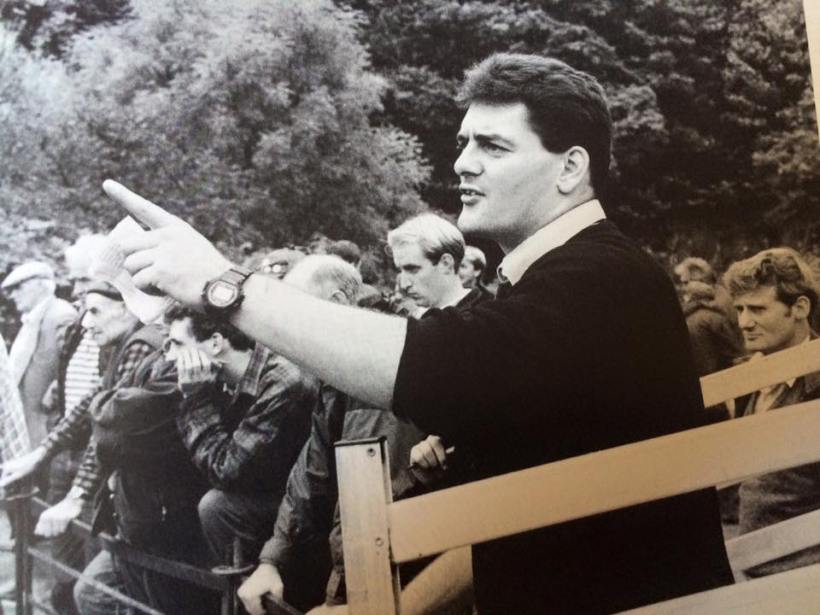
I’ve met and worked with most Lake District farmers over the years. Here i recall a farm visit to Jos Naylor in the Wasdale Valley one cold January morning.

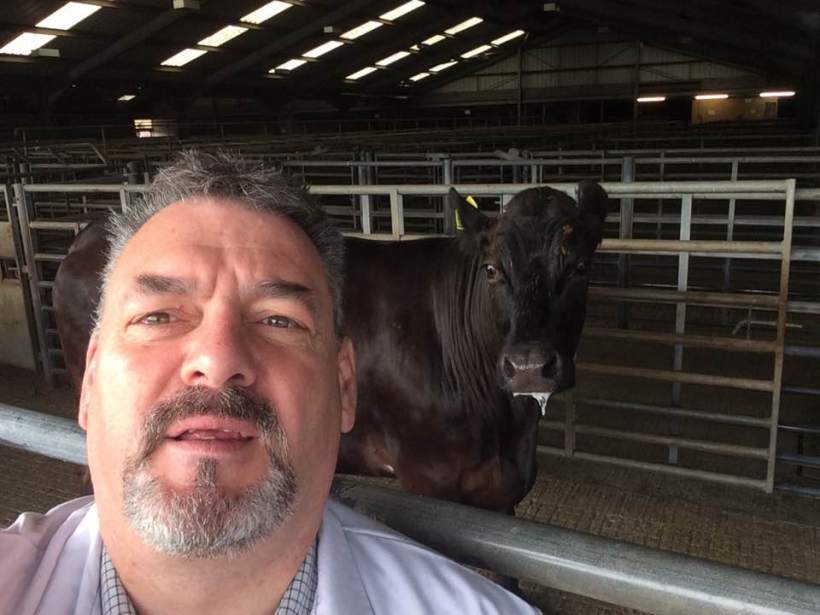
Photo taken by my friend and ex- rugby team mate Ian Mallinson.


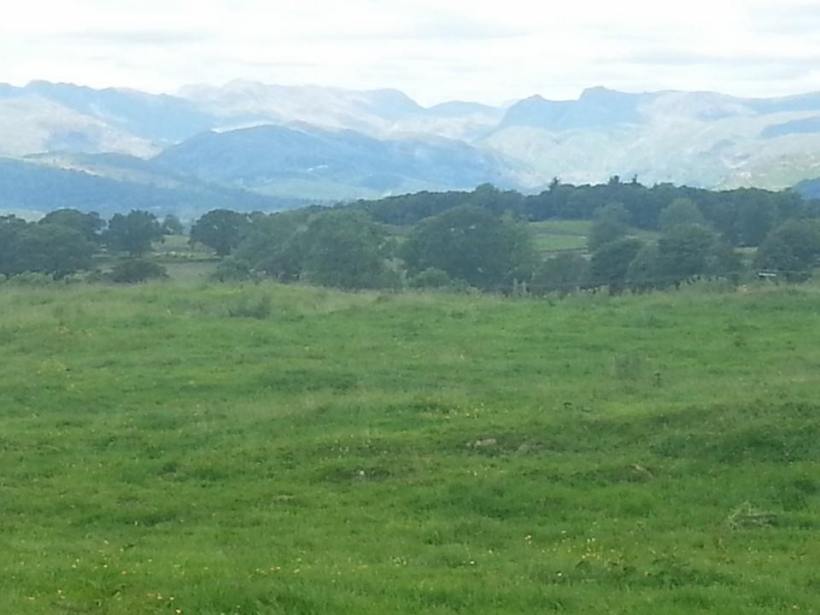
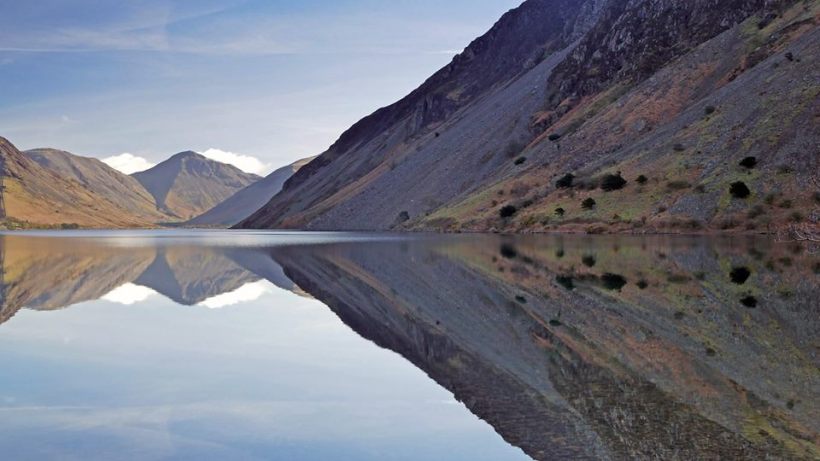
It is a freezing cold January morning as I make my way along the narrow roads of Wasdale. This is a truly remote part of the Lake District. Only a few miles from the Irish Sea, the Valley is dominated by some of the highest fells of Lakeland. Great Gable stands magnificently at the head of the valley flanked by the Scafells to the south and the Ennerdale fells to the North. Wasdale Screes fall sharply in to Wastwater. At 258 feet deep, it is the deepest lake in Cumbria. The lake bed is actually below sea level. The geography is stunning on any day of the week. A mass of tumbling rocks and boulders, with great swathes of scree, carved out and exposed by dying glaciers at the end of the ice age. At this time of year, with the winter wind and rain howling in from the Irish Sea, it is no place for the timid.

One can but imagine the Norsemen of the 10th century clearing the valley bottom to settle and colonise. For them perhaps it was almost a taste of home. Much later William Wordsworth was to describe the valley as “long, stern and desolate”. Perhaps he was visiting on day rather like today!

The working farms up here a hard places and it takes a special type of farmer to work them, in a land where local knowledge and custom is time honoured, trusted and proven.

Beneath the highest mountains at the head of the valley sits England’s smallest church. Dedicated in modern times to St Olaf, the main church beams are reputed to be taken from a Viking longboat over 1,000 years ago. My journey will not take me that far today.

It has been snowing hard and freezing at night. There is a bitter nip in the air and the swirling eddies of bitingly cold wind, chill to the bone. My car heater is on full, as I press on up the lake side road, my tyres smashing through the icy puddles.

I am on my way to see Jos Naylor at Bowderdale Farm. Jos is a legendary character. A world champion fell runner, he was often called “The King of the Fells”. His achievements on the hills are incredible.  In 1975 one of his greatest feats was to conquer 72 Lakeland peaks, running over 100 miles ascending 38,000 feet and in a time of 23h 20m.

The Cumbrian hills are both his work place and his hobby. Passionate about this landscape, he is both proud of the sheep he breeds and the landscape they live upon. Naylor’s have worked this valley for a few generations and Jos’s son Paul is following on behind and doing a great job. These are hard, cold and wet farms on the western fringes of Lakeland. It takes special people with unique skills to thrive in this environment. The sheep bred on the hills are also hardy. If they can survive harsh winters grazing on these fells then they can certainly do well later in life when they are often sold as draft ewes to more lowland climes. In my time as a Lakeland auctioneer in the autumn months, I sell many thousands of sheep from most of the farms in the valley. These are my dog days and the sales that I will later look back on with most pride.

I arrive in to the yard, and Joss is working amongst some young Herdwick sheep he has penned up. There are snowflakes scurrying and diving around the in the air. The cold makes me catch my breath. From the boot of my car I quickly don extra layers and some fingerless gloves. Jos acknowledges me and keeps working. I’ve come to see the sheep, and I start to work with him. After a while the job is done. He is satisfied with the outcome.

Only then do I notice that on his upper body Jos is wearing nothing but a cotton checked shirt, sleeves rolled up above the elbow and unbuttoned down to the navel. He is it seems oblivious to the cold. I expect that as the snow begins to fall faster we will retire to the kitchen for a drink. Not a bit of it. Jos leans back against the sheep rails and folds is arms across his chest. He begins to question me about Cockermouth Auction. This is the late 1990’s and we are still no nearer to getting our much- hoped for market. The old town centre site is working at maximum capacity and we are selling thousands of lightweight lambs from most of the farms in Wasdale and nearly every other valley.

“You would wonder where all these little lambs go” he says. I tell him that the vast majority of the lambs are slaughtered in Britain and sent in carcass form to countries all over Europe. Thousands of little fell lambs produced by Cumbrian farmers weighing around 30kg as they are sold, end up on tables from France to Turkey. This growing market is a godsend to all hill farmers who breed such lambs in the hills that have a limited market in our country.

I crack a joke. “You know Jos, these little lambs are Cumbria’s second best export after nuclear reprocessing. Jos laughs because he has a working relationship with BNFL and the Sellafield plant is just a few miles distant from Wasdale.

By now my fingers and toes are going numb. Jos doesn’t seem to notice. He is impervious to the cold. He asks me if I am still playing rugby. I tell him that I am however at 33 years old, I’m getting towards the end of my career, and my knees are hurting more and more.

Jos looks me in the eye. “Listen lad. If you enjoy it and still want to do it. It doesn’t matter if you aren’t as good as you used to be. Just keep doing it, because there will come a day when you just can’t”………

Those words stick with me and I often think of them years down the line when I am in my forties and still lacing up my boots. I still love it and still want to do it. I do so in the knowledge that soon the day will come when “I just can’t”.

“Still running then Jos” I say though chattering teeth. “Oh aye” he replies.  “I like to get up on the tops, clears me head, and gives me time to think”.

“Not on a day like today though” I joke. “Oh yes” he says in all seriousness, “wouldn’t be a problem. You see I know these fells, every bit of them, and I know me, what I can do and what I can’t. Too many people go on to the tops and they don’t know them, and they don’t know when to get off. Then when they realise they need to get down, it is too late”!

He goes on to tell me that not too many years ago, a crack squad of Special Forces people approached him to go out for a training session on the fells. Jos says that one by one he left them for dead as they gave up and dropped out, until the last one finally could go no further. Jos had to help him back down to safety, so exhausted was the soldier. “I kept him going with boiled sweets” he said. “He thought he could break me but it “nivver” happened”.

Jos tells me that all his power is in his legs. He is remarkably tall for a fell runner, but he is stick thin in the upper body. His legs are made of steel and judging by his dress code on a freezing January day, he is impervious to pain.

He does admit though he does like to warm his bones and has rather taken to spending time in the Canary Islands where he has bought a home. The thought of being in such a place at this very moment is very appealing, at least to me.

Our meeting has come to an end and Jos is eager to get on with more sheep work. He is going out in to the fields to “look the sheep”. I bid him goodbye and by the time I remove my winter clothing in order to get back in to the car, I lose Jos in the gathering wisps of winter snow as he half walks and half runs up the in- bye land above the farm. In a minute he is gone from view. It is a good job that I am not required to go with him. I couldn’t keep up!

By the time I leave the valley, my fingers and toes are coming back to life. His words of advice stick with me for years as I carry on dragging my ageing body around the rugby pitch, loving every minute of it until at the age of forty four I am forced to retire, because finally, “I just can’t”.

Jos also heeded his own mantra. For some years later at the age 70, he successfully ran over 70 Lakeland fell tops, covering more than 50 miles and ascending more than 25,000 feet. All of this in under 21 hours. I don’t think the words “Just can’t” are in Jos Naylor’s vocabulary.

KESWICK HERDWICK TUP FAIR

It is the autumn of 1995. I am 30 years of age and the new manager of Mitchell’s Auction Co Ltd. Mitchell’s operates the livestock mart in the town centre of Cockermouth, the market town bedecked by Wordworth’s daffodils each spring, and full of Lake District sheep in the autumn, brought to the market for sale from every valley in the county. The market company is one of the oldest auctions in the country having been created in 1873. As a boy at Fairfield junior school I could hear the auctioneers in full flow and so wanted to run across the car park to the auction. Now I am here managing the place!

There is one important sale that does not take place at Cockermouth Auction although it is always conducted by Mitchell’s. It is the famous Keswick Herdwick Tup Fair. For decades this event has taken place in the park lands above the Twa Dogs pub heading out of Keswick towards Penrith. With great care and precision, Herdwick breeders set up temporary pens in which to hold the annual crop of Herdwick rams, or tups as they are known in Cumbria. Not long after first- light, a procession of vehicles and trailers arrive at the field and the tups are expedited to the grass pens in preparation for the prize judging and eventual sale.

The manager of Cockermouth auction always conducts this sale. It is a long- standing tradition. This year for the first time, the sale is in my hands. I have been nervous for days leading up to the fair. I am new to the job, I don’t really know Herdwick sheep and I only know a few of the local vendors and potential buyers. It is a big responsibility but none of the Herdwick breeders seem to bat an eyelid. They all seem happy to have me selling at their main annual event of the year. Either that or they are good at hiding it!

I arrive early to show willing. It is typical tup fair weather, wet and windy. The clouds are lying low on the southern slopes of Skiddaw, towering above Keswick. Even the top of Latrigg is hidden from view. In front of me I observe a sea of green waterproofs, plastic leggings and wellies. There is an autumnal nip in the air and the leaves are falling from the trees and swirling in the breeze. The Lake District Herdwick farmers are impervious to the rain and cold wind. Winter hasn’t started for them.

Generally speaking the weather is always the same for the Tup Fair. The green landscape is broken only by the magnificent sight of the Herdwick Tups in the pens. There in front of me are 250 of the finest Herdwick males penned together side by side. It is a beautiful view. The older tups now in full bone and full bloom are pumped up like African lions. Striking in their familiar rudded – up (red) fleeces, another long- standing Herdwick tradition. They are testosterone filled pocket battle- ships ready to fight each other or ready to serve ewes, whichever opportunity happens first. The smell of the sheep, the wet wool and the rudd is all- pervading. It is the smell of autumn sheep sales.

It is getting towards tupping time when in just a few weeks’ time, the Herdwick ewes will be brought down from the high Lakeland fells and introduced to their new male friends. This is the only sale of registered Herdwick rams in the year. Each tup has been inspected by a panel of Herdwick Sheep Breeders Association members and has been judged to be physically correct and fit for sale.

Before me stands the cream of the crop, the pride and joy of each and every Herdwick Farmer who is selling. Many of the sheep will have been shown at various Lakeland agricultural shows throughout the year culminating late in the season at Eskdale and Wasdale. The Tup twinters often attract most interest. These are three year old sheep that are about to live through their second winter (twinters). They have not had the chance to serve any sheep being too young the previous autumn. As such they are untried and unproven. Some have massive potential and have been observed by potential buyers at various shows. Some have only been brought out to show at the very end of the season once the opposition has been assessed.

It is good fun watching potential buyers trying to get a good look at the sheep without appearing too interested. It doesn’t do for some buyers to broadcast that they like a certain tup. This can attract other potential buyers who respect the opinions of others and might even out- bid them at sale time. Herdwick tup buying can be a furtive business. Many times in later years I take a bid from a surreptitious hand flapping over the top of the wall, the owner of the hand trying hard not to be seen other bidders. More often than not everyone knows whose hand it is anyway. It is even more fun to knock the tup down to the hand and give the correct name out without even seeing the person. The thumbs up over the top of the wall was the sign that I had got it right!

But this is Keswick and today there are no walls. There isn’t even a rostrum. I have to stand on the ramp of a sheep trailer looking out over the sheep pens, with many bidders standing even further away behind the pens, and many farmers standing either side of the trailer. There is no microphone and I am expected to shout for about 5 hours which is how long it takes to sell 250 Herdwick Tups, one by one.

The judging has taken place, the prizes awarded and it is sale time. The rain is incessant and I stand on the trailer ramp with a shepherd’s crook which I use as a gavel, banging it down on the ramp to signify that a sale has been made. My other hand is trying to hold on to an umbrella, but it is a forlorn hope. There is water dripping in to my eyes and I am having to shout above the wind and rain to a large group of several hundred farmers all around me.

I have one asset by my side. Stan Edmondson from Seathwaite Farm is going to help me. He is a director of the auction company. He is also both a Herdwick legend and a Lake District legend. Anyone who has walked through the farm yard at Seathwaite heading for Scafell or Great Gable will have been greeted by Stan. His cheery wave and standard shout of “Aye- aye” will have been heard by thousands of Lake District visitors over the decades. He has a life- long experience of breeding and working with Herdwick sheep. He takes and interest in the people who visit his valley. “Where’ve you been and what have you seen?” is a phrase oft heard from Stan as people walk past.

Prior to the sale Stan tells me that he is going to stand with me and “keep me right”. This means he will point out sheep that he thinks may make a good price and to tell me the names of all the buyers who I don’t recognise. Stan knows every person on the field and probably their fathers and grandfathers before them. The problem is that Stan isn’t that good with names. Throughout the sale I am offered a number of suggestions as the hammer comes down. “Oh that’s what his nyam, thoo knaas, Johnny’s Grandson, thoo knaas him” and so on!

Stan is nearly 80 years old. His days as a world champion fell runner are long behind him, but he knows Herdwicks through and through. Despite being crippled with arthritis, he stands for 5 hours bent over his trusty shepherd crook, his eyes alive to the sheep in the ring, and the people bidding for them.

One by one The Herdwick tups are brought in to a little ring area in front of the auctioneer’s trailer. They charge about between me and the sheep pens. The vendors wave their arms frantically to try and make the tup show to attention. Occasionally they grab hold of the sheep to ensure it stands in the correct way, or to stop it jumping out of the ring. It’s a constant whirlwind of motion that I have to ignore as I urgently scan the crowd for bids.

I start the sale and manage to get quite a few sold but it is without doubt the hardest I have ever had to work. Herdwick Sheep Breeders are slow bidders. You cannot rush them. You cannot jump them up with big bids. You have to let each lot take its course. The grim reality is that no one actually knows how much a Herdwick tup is worth. Certain bloodlines are prized and there is only a limited gene pool within the breed. Tried and tested aged tups can reach a decent price. Young twinter tups of good potential can make a few thousand pounds. It depends on the breeding and of course the conformation.

Auctioneers pride themselves on stocksmanship and knowing the true value of the stock they sell.  A Herdwick auctioneer must accept that neither he nor many of the Herdwick shepherds have much of clue as to what the sheep are worth. Nobody minds how low you start, so you just keep taking the bids until they cease. At that point the stick is banged down on the ramp, the hammer has fallen and the sale is made.

In time as I gain experience, I learn to do the exact opposite of many top quality pedigree auctioneers that I have watched and admired. For in other breed circles the auctioneer judges the animal and the people bidding for them. If circumstances allow, they go big from the start, taking large bids in the knowledge that certain buyers will go with them and maybe even new records will be created. When I sell Herdwick tups, I take smaller bids as the lot progresses. This way I can often eek out an extra 500 guineas beyond where I might be were I taking much bigger bids. It takes longer but in time record prices will be broken using just this method.

I’ve been selling or rather shouting for over 4 hours without a break. In that time I have only sold 200 tups, but that is normal. Old Stan has been doing his best with the names. It is also a tradition in Lakeland to sometimes give the name of the farm rather than the farmer. So I am knocking sheep down to Nook Farm, Brotherilkeld, Troutbeck Park, Fell Foot and many more famous Lakeland farms. Often I have no idea who actually farms there. In time, I will grow to know each and every one of them. Even better, the course of my work as a Lakeland auctioneer will take me to so many of these farms on a regular basis. Time and again I am made welcome, and made to feel like I am part of the Herdwick world. So often I travel over the famous mountain passes of Lakeland on my way home from visiting Lake District farms. Always I feel I am blessed to do this for a job, and get paid for it.

Stan is also good at pointing out the sheep he likes. “This might mek a bit”. He is generally right, but not always! Eventually we are down to a handful tups left to sell.  A little Herdwick tup lamb comes in to the ring. Tup lambs are rarely sold, being given the chance to grow in to their second winter and sold as a twinter. This little lamb is only a few months old and is striking in that is jet black all over. Herdwick lambs are born very dark or even black. Their fleeces lighten with age. This little ball of fluff really is jet black.

It has been bred by another legendary breeder, Joe Folder now residing near Cockermouth. Stan lights up. “Ah now I like this” he says. “Set it off at 400 guineas”.

“What?” I am incredulous. It is a tiny little ball of fluff. “Set it off at 400 guineas” he repeats. Rather non- plussed I set the bidding off at 400 guineas. After one minute of scanning the crowd and constantly repeating “400 guineas, I’ve 400 bid, any more this time”. I turn to Stan and quietly apologise. “Sorry old lad, no one is bidding”

“Nay” he says “ah thowt it would mek all of that”. So I drop down to 50 guineas and immediately there is interest. 5 minutes later the bids have been coming in thick and fast. Finally with a last shout “all done? Last chance, hammers up, goes this time”…. The Herdwick tup lamb is sold for 400 guineas. Stan is triumphant. He thumps his shepherds crook on the trailer door “there thoo is” he beams “I telt tha”.

Joe Folder, smiles and winks at me. It is a sign of approval and we become friends from that day forward. The buyer of the lamb is non- other than Jean Wilson, a lady feted within the Herdwick world and far beyond. Jean Wilson is synonymous with Herdwick Sheep. Her rock by her side is her husband Derek. Years later Derek tells me that “Jean was bred to breed Herdwicks”. It is in her blood. She will travel the world to promote Herdwicks and her wise council is sought by many a young breeder starting their Herdwick career.

Like so many of the old school breeders, her knowledge of the Herdwick sheep and her skills are all encompassing. Meet Jean at any show or sale, and she will know the history and breeding of not only all of her own sheep but probably most of the other farmers sheep too.

Years later I was required to inspect and value many of Jeans best sheep and also the sheep of many other Herdwick Breeders in the foot and mouth epidemic of 20011. This was without doubt the hardest, most upsetting, soul- destroying job I was ever asked to undertake. For in 2001 these sheep were wintered away from home on the fertile soils of the Solway plain on the northern shores of Cumbria. Jean and so many other farmers could never visit those sheep or see them again for foot and mouth disease was raging in north Cumbria and the government  deemed that the sheep, healthy or not, could never return home and worse still, had to die.

The sorrow in having to speak to Jean after the deed was done will stay with me forever. Even then through the tears and upset, she was able to tell me which sheep I had inspected, their breeding, their bloodlines and their value to her which far outweighed the monetary valuation I had placed upon them. Later that night I cried my own tears behind closed doors. Tears for Jean and all the other breeders and for the sheep themselves most of which were not diseased, but slaughtered in perfect health. What joy to see Jean and so many other Herdwick breeders rise again although it has taken a long time and the pain of those times will never be forgotten.

Recently while speaking at a farmer’s dinner I told the tale of the little jet black tup lamb. I had forgotten that Jean had bought it and was telling the story simply to mention Stan’s instruction to “set it off at 400” and how I eventually got to the price.

As I started to tell the tale. Derek Wilson who was in the audience with Jean, stood up and stopped me. “Do you remember who bought that lamb” asked Derek?

“Err no” I replied.

“It was Jean and when she got home with that laal black thing I bollocked her for bringing it back”

Jean immediately stood up. Leaning backwards with her eyes almost closed as Jean does, she came right back at Derek “ah but you’ll hev til admit” she said to her husband, “eventually he did make a fair decent tup”. Derek had to agree and of course Jeans idea of a decent tup is normally a pretty good recommendation! 22 years had gone by since Jean purchased the little jet black lamb but she remembered the sale as much as I did. “There was just summat aboot him I rather liked” she would tell me later.

So my first ever Herdwick Tup Fair in Keswick is over. I have survived. It even stopped raining and I was able to remove my waterproof jacket. The business is concluded, tups loaded into trailers or just left in the pens, and everyone retires to the Twa Dogs Inn. I sit with Geoff Edmondson from Langdale and we have a pint of Jennings Beer. Geoff sits back in a relaxed position with his rudded waterproof leggings shoved down over his wellies to protect the pub décor. He takes a sup then folds his hands across his chest. “Well Adam Lad, do you think you were getting the hang of it”. “I didn’t think I did too badly for a first go Geoff”. He laughs. “Don’t worry about it. I’ve been among Herdwicks all my life and I’m still learning the bloody job… like”

Soon the traditional singing has brought the bar to life. Glen Wilkinson from Tilberthwaite whose flocks run across the Coniston fells, has his thumbs shoved firmly down in the pocket of his jeans. His head is cocked to one side, cheeks ruddy from the warm glow of the fire. Eyes closed in concentration he breaks into a bass baritone version of “Black Velvet Band”. We all sing the chorus in raucous fashion. Then David Bland from West Head stands up. His sheep run high up along the Helvellyn range. He takes a deep breath and then word perfectly sings “Old Shep”, in a version as good as the King himself. Some of the younger farmers cajole Syd Hardisty from How Hall on the shores of Ennerdale. “Come on Syd, give us Jobby Teasdale’s Warlick!” Syd stands up and his own unique rambling style, half sings and half recites his famous party piece.

I am relaxing in the warm glow as day turns to dark and thinking to myself, “This is great but if I’m doing this sale again next year, I’d like to have it in Cockermouth auction”!

The following year after some hard work on my part I have persuaded the Herdwick Sheep Breeders Association to allow Keswick Tup Fair to be held in Cockermouth Auction for the first time ever. The older breeders who have been to Keswick come rain or shine for decades are unhappy. Tradition is tradition. Some of the younger breeders and one or two influential Herdwick Council members have backed me and are prepared to give it a go. That is another story!


Welcome to the Lake District – Wasteland or Wonderland?

Recently a journalist from a national newspaper described the Lake District as a sheep- wrecked wasteland. It is not the first time journalists have sought to de- cry farming in Cumbria. This man has been making a habit of it having written about the need to re-wild areas like Cumbria, claiming that sheep compact the vegetation and soils on Lakeland’s fells, exacerbating surface water run- off, contributing to flooding issues, destroying flora and fauna and so on. You get the picture.

His comments were generally not well received in Cumbria. It wasn’t just farmers that bristled but also owners of tourist businesses  and I have to say some environmental bodies who work with farmers in Cumbria too and found the approach unhelpful. People who know and love our county may not be dissuaded by controversial sound bytes designed to increase the author’s profile, but to anyone reading newspapers and considering visiting Lakeland for the first time, they may well have been dismayed to read those damaging and deliberately provocative comments. Farmers maintained a dignified silence to the point where they were goaded on social media by the journalist, desperately seeking a reaction. Few bothered. The most ardent environmentalists are of course singing the praises of this re- wilding approach.

I cannot comment on those books or articles. I haven’t read them in full. I have however heard other people’s thought’s. Whilst most have found the extremes of sheep removal and re- wilding unpalatable and for some quite laughable, there was an acceptance that farm management could and should make positive contributions to protect and conserve Lakeland’s environment in future, but not at the expense of the farmers or all of their sheep!

So is our beloved Lake District a wasteland or a wonderland? 40 Million Tourist’s visit Cumbria annually spending around £2 Billion. That doesn’t sound like a wasteland to me. I’ve never met a tourist yet who doesn’t love to see sheep on the fells as they grind and sweat their way up the well- trodden paths of Lakelands finest fells. What better a back drop can you have as you sit and eat your sandwiches in the gentle summer breezes on the tops, watching the Herdwicks grazing the slopes, listening to the faraway bleat of lambs, momentarily lost from their mothers in the thick grasses and swathes of bracken?

Farmers tell me that on many fells and commons the grass sward is quite thick these days, butterflies are returning and most of the land managers I know are proud of the wildlife, birdlife and other habitats on their farms.

So what is the story? Well, it is common knowledge that in the austere years following WW2, this country and many other European countries were counting the cost of war. There were food shortages and rationing. Successive governments sought to get the country back on track. The farmer was the housewives best friend. She needed the dairy man, the shepherd, the beef farmer and the pig producer like never before. Over one third (33%) of the weekly wage was spent on food. Our farmers were respected for the fine job they did. Food was a necessity and not that readily available.

Gradually over the next few decades food austerity began to dwindle. All the while food production was in full swing. The new common market gave farmers quotas and targets, positively supporting increasing production through various measures. Add to that new technology, better farming methods and increasing yields and it did not take that many years to reach saturation- point. Crazy as it sounds we were soon over- producing. We well remember the Butter Mountains and wine lakes as excess stocks were bought and stored under what was simply called “EU intervention”!

In Cumbria during my working life our farmers were paid subsidies to keep more breeding stock via a host of support measures. There were headage payments for breeding cattle and sheep, top- up measures to ensure a guaranteed price on some prime stock at the time of slaughter and tradeable quota’s for milk production and sheep. The result in nearly all upland areas of the UK was that farmers kept more and more stock to take advantage of the subsidies. Who could blame them? I would have done it and so would most people. As a result, more sheep were kept on the fells than ever before, more cattle grazed in the valleys and more milk cows put through the dairy parlours all across the country.

The general public did not complain because food was becoming cheaper year upon year. This has continued to the point where the average food spend as percentage of earned income is now estimated to be as low as 11%, a far cry from 1950. What this means is that the consumer has far more disposable income to spend on other goodies. Food is so cheap it has become disrespected. My grandmother would scrape every last scrap of margarine from a tub. Nothing was wasted. Food would be re used or re- heated by her in the following days. Grandfather raved about three day old lamb hotpot which he claimed he would happily eat every day as the flavour matured with each re- heat. Today it is not so. Food is no longer valued by the consumer. In 2015 UK households binned over £13 billion of edible food, nearly £500 per household per year.

Out with the rubbish has gone public and political respect for farmers and also consumer knowledge about food production. It is a travesty that young people learn so little in schools about farming, food production and the environment. Indeed all the talk about farmers for many years has been the misguided myth that they are production subsidy junkies, living in high old- fashion, driving large country cars and abusing the animals they farm in search of maximum production and profit. A visit to and a chat with any lake district farmer would soon put paid to that.

Many farmers in the Lake District are very good at talking to the public. They have to be as most Lakeland farms are criss- crossed with public footpaths leading to and from the fells. My old friend and auction mart director Stan Edmondson positively revelled in meeting the stream of visitors trudging past Seathwaite farm in Borrowdale, heading for Great Gable or the Scafell’s. “Where’ve you been and what have you seen?” was a phrase that many will remember him by. In this and other respects farming is linked arm in arm with tourism, indeed perfect bed- fellows in areas like Cumbria. So much so that Cumbria Local Enterprise Partnership is currently drafting a rural growth plan linking farming and tourism tightly together.

By the late 1980’s it was clear that some of the Lakeland fells were becoming over- grazed. Solutions were offered and on some fells farmers were financially encouraged to reduce the numbers of fell ewes grazing on high during the winter months. At this time a plethora of non- governmental organisations began to grow with a very fixated view on how the environment, rivers, lakes, habitats, flora and fauna should be managed in areas like the Lake District. By the mid 1990’s production support had disappeared. European and government policy dictated that support payments to farmers should be based on environmental rules and outcomes.

At this point the relationship between the farming community, government agencies and environmentalists began to sour. Farmers were now being asked to keep even less sheep and cattle in the name of environmental protection. Blamed for the loss of habitat, over grazing, water quality and all the while being ordered by supermarkets to offer uniformity in supply, quality and conformation (remember the wonky vegetables) and at reduced or even penal prices, times suddenly got pretty difficult for farmers.

The BSE crisis of 1996 followed by the collapse in Beef prices, then a collapse in sheep prices, Foot and Mouth disease in 2001, an subsequent years when there was no export market, brought the livestock farming industry to an all- time low. Hard farming areas like the Lake District suffered as badly as any other area of the country. Many farm businesses were able to survive only with the subsidy payments available, using this money to prop up loss- making livestock enterprises. Profit almost became a dirty word in farming.

Sound business advice would have suggested that those farmers doing worst should actually cut and run, sell up and let those of the biggest size and scale swallow the smaller poorer farms. It didn’t happen. Why? Well here is the rub to all of this. Despite all of the issues and problems that have beset the farming industry over the last thirty years and more, there is one factor that remains unaccounted for and that is the human factor, farmers themselves.

Generations of farming families have worked these hills and valleys. There is pride and stoicism. It is passed from generation to generation and is bred- in, rather like the hefting gene in genuine fell sheep. In the bad times young farmers have perhaps had to take second jobs and work elsewhere but so often there is hope and expectation that one day, the farm will be theirs. The cycle will continue.

At this stage of my own career as a Lakeland auctioneer I have worked with at least three generations of family farming and my how times have changed. What does not change is the passion and the care to farm the Lake District “to the best of our ability”. I talk to many young farmers whose priority is to learn the skills peculiar to farming in their valley or on their fell. Every fell or common is different. Now they are also challenged with learning new skills, how to improve the bio- diversity on the farm, how to manage the water, how to deal with flooding. These are all part of the modern Lakeland farmer’s new challenges and working practice. The good news is that I haven’t met many farmers who are not up for the challenge. I see this a huge positive for the government, general public and all those concerned principally with conserving the environment.

So how is it going to work in the future? No one has crystal ball good enough to see through the hazy maze of Brexit, future government policy, climate change, international politics, and a world population set to increase from 7 billion to over 10 billion in the next thirty years. These are global issues we have to address. It is now clear that we have to put the past behind us and craft a land use policy in this country which achieves some very simple aims: –

  • Sustainable food production
  • Viable farming
  • Conserve and enhance our natural environments
  • Protect our fresh water supplies.
  • Farmers collaborating with farmers to achieve all of the above.

We cannot stick our head in the sand. At some stage in the next couple of decades we will go hungry in this country. We have such a reliance on cheap imported food from all over the world that it is dangerous. The reality is that food importation costs are going to rise, climate change will effect food production, pressure on fresh water supplies will increase significantly and the potential for political and religious disagreement is only going to strengthen.

As a nation we have to plan for the future. We have to get past short- term government thinking with manifestos designed only to win votes at election time. As a country we have to be bigger than that. The four aims I suggested above or not in any way exclusive. Instead they are totally linked and mutually inclusive.

In my opinion, the group of people best placed to deliver those aims are farmers. The cheapest, most cost effective way to deliver those public benefits is by supporting farm businesses. They have the skill sets and the ability with training and guidance to make this happen and achieve those aims. How do we do this?

I would be crunching the numbers to see what level of sustainable food production will be required to feed a population in the UK expected to exceed 80 Million by 2050. I’d be working with the farming community to improve productivity and efficiency under the concept of “more from less”. In other words how to grow more food with reduced inputs and costs. This means embracing new technology, improved working practices, better training and exchange of knowledge.

At the same time I would be engaging the UK leaders and experts in environmental protection. I would be asking and agreeing a set of goals and targets focusing on areas of greatest need. I would be looking to improve bio- diversity in those areas, encouraging improvements to habitat, improving our water quality and how we actually manage the land particularly in water catchments and areas of potential flooding.

All of this has to come at a public cost. Food production and environmental management is not a freebie. If you want cheap food in the shops sold at or under the cost of production, then food producers have to be subsidised. This is where reality has to kick in for supermarkets and other food processors. Environmentalists cannot expect farmers and other land managers to carry the cost of environmental protection and enhancement. Nor can they reasonably demand that their need of financial support is any greater or more important than the farmers. If the population starts to go hungry, they will forage the environment to survive. A balance is clearly required. We’re already past the “them and us” stage. They have to work in partnership.

If government buys in to the goals I suggested above, they then need to gather all parties together. All of them have their own goals and agenda’s. Through discussion and negotiation, a common set of goals and targets can be achieved. Everyone will have to settle for wins and losses, but at the end of an embryonic and totally new land management policy will be tabled and agreed to with which to go forward.

The final job will be to cost and apportion the level of public funding required to achieve the goals and targets. Again it will an inclusive subsidy regime rather than exclusive. Leading the field will be the farmers who will be tasked and supported in producing great food, cheaply and economically whilst at the same guaranteeing to conserve and where possible improve the natural environment.

This has to happen on a regional or even local basis. One size fits all national policies have not worked. Local knowledge on the ground has been ignored far too often by government people in far- away offices who have neither the knowledge nor the experience to administer agriculture and environment policies. Someone at a high level needs to grasp this fact and put their head above the parapet. DEFRA and other agencies are simply not fit for purpose in their current state.

Once the policies and goals are fixed, a public purse needs to be tapped in to in order to fund food production and environmental support. All the while the government must actively promote the new land use policies to the public. Consumers need to be educated in a number of ways. This will include the importance of all the land- use goals, British Values whereby it is no disgrace to promote “buying British” or even better “Buying local”. Incidentally British values are already supposed to be taught in Britain’s schools and colleges.

The public would then hopefully realise that once again, the farmer is a friend, perhaps in an even stronger way than 70 years ago when food production was the only goal. In the words of Bob Dylan “the times they are a- changin”. The problem as time goes on is that the changes are happening faster and faster. While politicians dither leading up to Brexit we are losing valuable time to get our agriculture industry in order and set up for the next round of challenges.

We need to be preparing the next generation of young farmers right now. They will be tasked with managing our lands and producing our food in future. The challenges facing them will be harder than ever before. Their position and status in society will be a key driver. The public support package needed has to be identified and put in place as soon as possible. Farm business support organisations like our own Farmer Network have been promoting these policies for years and have been in some ways, ahead of the game.

Farmer’s work best when they work together, but over the years the collaboration between farmers has reduced or even disappeared. In that respect we lag way behind our European counterparts. We need to get it back. Why? Because everyone is good at something, but no one good at everything. There is the opportunity to network, share and learn together. All of this will help achieve the land use policies we need. The same goes for government agencies and other land- use organisations. Too many are skilled in their own speciality but know nothing about the practicalities of farming. Just as our farmers need to become more environmentally savvy, so the environmentalists must become more farmer savvy. It has to happen in order to create joined up policies. There has to be a balance.

In thirty years’ time, I would love to think that our “wonderland” Lake District still attracts visitors from all over the world, but it may not be the case. If it is not, then I pray that at least we can feed our population and protect our precious little corner of the planet. I cannot get away from my strongly held belief that is the young farmers of today who will provide this for the generations of tomorrow.

The good news, and I know this because I work with them regularly, is that our young farmers are keen, enthusiastic and totally committed to farming the Lake District in the future. Far from the wrecked wasteland that some have sought to portray I believe our marvellous landscapes will be enhanced in future, our food production systems and our water quality improved. All of this will be achieved by our farmers many of whom are just starting their careers now, but only if they are properly and sensibly supported.

What a responsibility, what a challenge!
SELLING CALVES AT PENRITH AUCTION. “£20 AND I MEAN IT!”

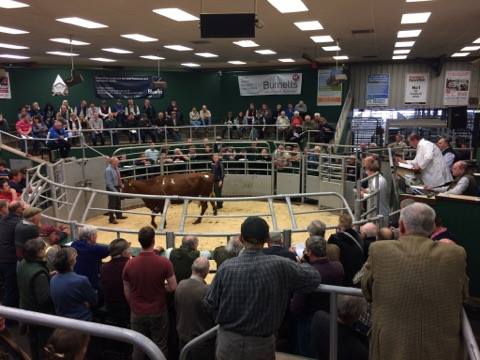
Back in the late 1980’s at the start of my career, it was custom and practice to put trainee auctioneers on to sell feeding and rearing calves. In Penrith market these weekly sales consisted of large numbers of dairy bred black and white bull calves together with a smaller number of beef breed calves which would be bought either to feed on and eventually fatten or keep as herd replacements.

 The black and white calves were much in demand for the European export market for veal, with several companies throughout the UK operating this type of business. So a plethora of professional calf buyers would climb in to the ring each Monday morning at Penrith.

My friend and colleague David Jackson was the young auctioneer above me and he had been selling for a few years, starting as a teenager. He had by this time worked his way in to the groove and had a good relationship with the calf buyers, you could say a mutual respect.

Some of the buyers were good to deal with, friendly and approachable. Others were almost tyrannical and would happily use fear and intimidation against any auctioneer in order to gain an advantage. My job week after week was to learn from David by pushing the calves in to the ring for sale or being on the rostrum clerking the sale.

I got to know the buyers quite well. There were some real characters in this field. The Forbes family and the Ross family from just over the border in Scotland were all related. The craic with them was generally good but it didn’t take much for a very short fuse to be lit. If that happened, then all hell could break loose in the ring. Dennis Thwaites and Stanley Mudd were two men who lived locally and knew many of the vendors in the market. They got on with their job quietly.

There were also some buyers who came up from Lancashire, one of whom, as I soon found out could be very volatile. From the very start did not seem to take to me at all. His name was Arty. He could fall out with himself on any day of the week. If he wasn’t shouting at the auctioneer, he might shout at the other buyers.

Within the buying circle in any auction mart, there are certain clicks or relationships whereby the buyers will not bid against one another. In other words they agree that one will stand back for the other if they are bidding. This is common practice in any auction mart. The buyers might just be long standing friends or the companies they buy for have working relationships. You can walk in to any auction ring and if you look carefully you can see little nod or winks between buyers meaning “this one’s for you” or “I’ll have this one”.

In a ring full of buyers you would hope that there is enough competition to ensure that despite any “standing” relationships, there will be at least a couple of bidders that will bid the animals to their full market value. There will always be times in auctioneer’s career when he may not have a full ring of buyers or they have decided collectively to all “stand” for each other. At these times there is great pressure on the auctioneer as he has to then drive the sale and do whatever he can to get the animals to market price. For young auctioneers with little experience this can be particularly daunting. Especially when the buyers are intimidating the auctioneer by trying to drive the prices down, or not letting the auctioneer get the bidding started.

Arty didn’t like me. It was clear to see. He would barely engage with me in the ring and was pretty rude. I always knew the day would come when I would be given the opportunity to sell calves. A few weeks later the chance finally arrived. David had taken a week’s holiday and Monday morning would see my first attempt at selling calves. As soon as I arrived at the market I was nervous. In those days there were three hundred calves or so to sell individually. One thing in my favour was that the demand for these calves was very high. All the buyers needed them which was putting pressure on the different clicks who had to “stand” for their mates but perhaps didn’t want to.

Working against me was Arty, who had already canvassed the rest of the buyers to get them to work with him. His intention, I was told later by another buyer was to have me “off by the stocking tops”, meaning that I they would not bid properly for the calves, break me and purchase the entire sale for a knock down price.

I climbed in to the rostrum clipping the little microphone on to my tie. In my hand was my personal gavel made especially for me by my late Uncle Parker, fashioned from a gnarled piece of hardwood. The first calf entered the ring, a black and white bull calf that I thought might make towards £160.

Immediately Arty was on the attack, grabbing the attention of the buyers, pointing at himself, meaning “leave this to me”.

“Twenty” he shouted “twenty pounds here”.

“One hundred and twenty bid” i shouted and set off to sell the calf.

“whaaat?” shouted Arty “I said twenty pounds and I mean it”. I refused to set off at that ridiculously low figure so I came down a little and then started to work back up again. Gradually other bidders joined in and eventually the calf was knocked down at a sensible price. The sale continued. All the while Arty was chuntering away in my ear, trying to unsettle me. I kept my head down and stuck to the task, all the while feeling pretty miserable thinking “is this how it is going to be for the rest of my career?”

About 100 calves in to the sale Arty decided on a different tack. The custom and practice in the calf ring was to take £2 and £3 increments. In other words a series of bids would go “£90, £92, £95, £98” and so on.

Selling another black and white calf Arty had given the final bid, the calf was knocked down to him at £150, the previous bid being £148. Immediately he started waving his hand in my face. “I only bid you £1 and £1 you will take”. This was show down time and I knew it. There was no way I could take a £1 bid. David Jackson had not done it and neither would any other of the auctioneers. I had to stick to my guns.

“It is £150 Arty and it is staying at £150”. He tried all ways to get me to back down. In the end he completely lost his temper as I refused to budge. Sadly he had backed himself in to a corner.

“Bring the next calf in” I instructed. “Leave the last calf. If Arty doesn’t want it, someone else can have it”. Delivering a final torrent of abuse, Arty left the ring at speed. Keeping deadpan I just continued with the sale. Outwardly I was trying to show some calm, inside I was breaking up, trying not to replay the recent events or question myself whether I had done anything wrong.

The sale was drawing to a close, I had just about got through it. Then the door to the ring burst open and back in came Arty. “Oh no” I thought. “Here we go again”. Instead he just came back in to the ring and stood there quietly.

A few lots later the sale was over. The buyers scurried off to the office to get their bills. I breathed a huge sigh of relief and slowly my heart rate began to fall. At the same time a quiet sense of satisfaction came over me. I had got through it and survived the worst that Arty could throw at me. I had done it once and I could do it again when the chance arose.

Slowly I made my way back to the auction office. As I got there I walked bang in to Arty. I was ready for an almighty bust up yet again. Instead he walked up to me, shook my hand and said, “You really should have taken a £1 bid”. With that he was off out of the auction.

I found out later that he had gone to my boss Richard Morris and asked for me to be removed from the rostrum. Richard backed me to the hilt saying as far as he was concerned, I was in charge of the sale – end of! I always appreciated that.

Perhaps the other buyers had also spoken to Arthur as well, I do not know. However from that day forward we never had a crossed word whenever I sold calves. Some years later when I was the manager at Cockermouth Market he rang me and asked if he could come and buy calves each week. I welcomed him like an old friend and he supported the market regularly until the export calf trade drew to a swift close during the BSE fiasco. Not once was there a wrong word and we often shared a joke in the ring!

Now 29 years have gone by. It is June 2017. Today I am back helping out at Penrith market selling calves, for one day only. There is nothing like the same number of calves to sell but there are still a few professional buyers in the market. The only faces left in the ring from the old days were “young” Andrew Ross and Stephen Pye fron Lancaster. All those years ago they were fresh- faced youths, just out of school. Young Andrew used to come to Penrith to buy calves with his dad, standing in the ring with all the other buyers including Arty.

I haven’t sold calves for years and I thoroughly enjoyed it today. I struck lucky. The calves were in great demand especially the black and whites. There was no “standing” or clicks in the ring. There was also a lot of banter, all good natured. Last Christmas I took part in a charity concert playing my piano and singing. Local farmer Les Armstrong from Kirkoswald delivered a brilliant soliloquy on stage about being a farmer. Les has done much for the farming community fighting our corner in the media and even at government level. Dressed in a tattered old bib and braces and wellies he brought the house down. Part of his act was to decry my piano playing ability which he likened to Les Dawson. “I’ll get you back” I promised. Today Les Armstrong was in the auction selling good quality calves as he regularly does. I hadn’t seen him since Christmas.

“It’s a Belgian Blue” he said entering the ring with his calf.

“No it’s not” I said over the microphone.

“yes it is” he responded more forcefully”.

“It is not”!

“Why? Is the passport wrong or something”? Les began to look vexed.

“No” I replied “We’ve called them British Blues…. for the last ten years”. Revenge is a drink best taken cold. Of course this was all in good fun but I was still pleased to see his calves make a good price. It won’t be long until it Christmas comes around again!

Some of the calf buyers still tried to pull me back but I have learnt a little over the years and just pushed on. I did remember my old pal Arty. One thing was for sure, I wasn’t going to take a £1 bid!

Who wants to be an Auctioneer?

Who wants to be an auctioneer? it’s not a question many careers teachers will ever ask, but my mind was pretty well made up by the time I left school. As a child I spent every school holiday at my grandfather’s smallholding near Ulverston among sheep, cattle and ponies. This fired my enthusiasm for the countryside and its guardians, especially the farmers.

Those school holidays were magical times. It seemed like the sun always shone and every Thursday was spent at Ulverston auction mart selling Grandad’s lambs. I also loved watching the calves and pigs being sold. The gruff tones of the auctioneer George Lawrence used to enthrall me and scare me. When sitting at the auction ringside I would hardly dare move in case he might think I was bidding. Then back at my Grandad’s I would sit on the gate and pretend to auction the sheep.

My paternal grandfather was Robert Jackson. He was a coal man by trade and carried the black gold 6 days a week from the age of 16 until nearly 50 years of age. Then, every Saturday night, he and my grandmother whom we called Nannie, drove around Ulverston collecting coal money. He had to collect money on a Saturday because most working people got paid on a Saturday lunchtime as they finished for the weekend. Go later in the week and there would be no money left for the coalman. His Saturday night treat after collecting his debts, was a late fish and chip supper. Smothered in salt and vinegar, poured from a white plastic bottle that lived on the kitchen table, this was supplemented by several rounds of bread and butter. Then he would sit in his vestibule, banished from the kitchen, to smoke his pipe, a harsh blend of tobacco called Condor.

When he finally gave up smoking in his 80’s, he proudly presented me with his pipe. By then I was living in a third floor flat in the centre of Penrith. I visited the local tobacconist and bought some Condor not knowing that it was an extremely potent tobacco. Back in the flat, I opened the living room window to smoke my pipe and watch the people walking up and down Devonshire Street. Within thirty seconds a green cloud of nausea descended upon me and I was nearly sick on to the pavement some 40 feet below. The pipe was never smoked again and I still have it in a drawer somewhere.

Grandad Jackson loved farming and livestock. He would devour the Farmers Guardian every friday morning like a kid with a comic. As a child he used to help in Burch’s slaughterhouse at Swarthmoor. He always wanted to farm and he always kept horses and ponies. As a boy looked after the magnificent Shire horses that pulled the coal wagon in his early years of coal merchanting. Later my mother had ponies to ride. Later still there were ponies for me and my sisters. Indeed Nannie loved to produce top quality show ponies. She was in her element grooming ponies, washing them, plaiting manes and showing them at agricultural shows and events all over the North West. She was to tell me not long before her death that these were the happiest days of her life.

Grandad Jackson worked tirelessly and conscientiously. Money had to be saved and life was lived in a plain and thrifty manner. There were no indulgences. There was always good food on the table and plenty of it, but he rarely drank anything more than tea or plain water. Morning porridge was taken with salt and not sugar. As I young boy I couldn’t stomach it, for which I was berrated.
A treat for the grandchildren was a slice of ice cream from the huge chest freezer which was full of home produced lamb, or half a pig, or a heap of blackberry pies made in the autumn. One of those pies with fresh cream at Christmas was an even greater treat. As a child I would wait for their car coming up the road to our family home near Cockermouth. It was usually on Christmas Eve and I knew it was full of presents and all manner of fantastic home- made produce, pies, jams, pickles, piccalilli, it was endless.

With his savings Grandad also bought land and achieved his goal in life to become a farmer. His land was in unconnected blocks around the village of Great Urswick. He bought a few breeding sheep and some young stirks to fatten up. By the time I was spending my summer holidays farming with him, he was in full swing. He was helped by many local farmers including his great friends Harry Woods and further down the road, Alan Woods. He also bought Burch’s old slaughterhouse in Swarthmoor and turned it in to a house for himself and Nannie.

My first memory of selling his lambs at Ulverston Auction would be when I was about seven years of age. We started early at 6am one Thursday morning. Despite it being the month of August, there was a real chill to the morning, with whisps of fog hovering above the grass. We went across to the sheep and selected or “drew” the prime lambs for market, loading them in to the trailer. They were Suffolk cross lambs with distinctive brown heads and a blue mark on their backs. Only after this process did we have some breakfast, cold toast and marmalade. Then off to market.

The sale began and I peered across the ring for ages waiting for those brown headed lambs to appear. Suddenly, the next lot came crashing in to the ring and they were Suffolk lambs. In a flash I leaped into the ring for the job given to me by Grandad was to “show” the lambs. In other words move them around the ring in front of the buyers, so that they could feel their backs and assess their condition. Good meat and not too fat was always the choice. So I pushed those lambs around for all I was worth. The hammer fell and they were off out of the ring. “Laal” Johnny Matterson walked them away to the buyers pens. Many years later, The Matterson family were to become great friends of mine. Johnny was a special little man, no longer with us, but his memory lives on strongly.

Proudly then, I climbed back out of the ring only to meet my Grandad, who in a loud voice said, “you did well Adam but these are my lambs coming in now, you’d better get back in” Everyone laughed. Embarrassed, I climbed back in again. I had got the wrong pen of lambs. The farmer whose lambs i had sold shouted across the ring to Grandad “Don’t worry Bob, he did a grand job…. for me” and he chucked me 50p, which was a fortune back then. I didn’t know it but it was my first earnings in an auction mart.

42 years later In 2014, I was invited to sell at Ulverston Auction mart as a guest auctioneer. I was thrilled. As I stood on the rostrum prior to the sale, I took a few deep breaths and remembered for an instant sitting on those old wooden benches, watching sales some forty years and more previously. I mentioned this to all the farmers before I started to sell. I said that it would have been beyond Bob Jackson’s wildest dream that his Grandson would one day be selling at Ulverston Auction. Of course Grandad and his generation are long gone now but it was an emotional moment for me. I had to take a deep breath and quickly get my head together. The sale went well and if I should never get a chance to sell again at Ulverston, I will treasure the time I stood in that rostrum taking bids.

The Dairy Shorthorn Sale

Only two generations ago, most farms in Cumbria bar the hardest hill farms, carried a few dairy cattle, fattening cattle, a flock of sheep, some pigs in the byre and a few hens with maybe a goose or two fattened for Christmas. A living could be made, sons welcomed in to the business and daughters married off in style further down the valley.

Penrith’s town centre auction mart was a hive of activity each and every Tuesday. Hundreds of dairy cows would be offered for sale brought from farms the length and breadth of the county. Scrubbed up clean with udders gleaming, fresh and full. The day was for trading and socialising. The market buzzed from the sale ring to the public bar. The Agricultural Hotel would be thick with the fug of tobacco smoke, resounding to the sound of clinking glasses, raucous laughter, farmers chatter and the heavy drop of domino’s on oak tables. For many farmers this was their only trip away from the farm each week.

In the sale ring the auctioneers worked their magic whilst afterwards the dairy dealers worked theirs, using every trick in the book to find fault with their purchase and haggle some of the sale price back from the beleaguered farmer.

Most of the cows were dairy shorthorn- bred with a few new- fangled black and white Friesian types mixed in. The beautiful shorthorns often red roan in colour were hardy honest reliable cows. Over the years they have slowly died away, replaced by the high- yielding leviathans from Western Europe and the Americas. A few shorthorn herds have continued, keeping the tradition and the breed alive but sales are few and far between. Penrith is one auction mart that does regularly sell Shorthorns every year, but the age of the 300- cow weekly dairy sale is long gone.

Today Penrith auction hosted a rare collective sale of Dairy Shorthorn cattle the like of which has not been seen for many years. The catalogue includes cattle from  several noted Dairy Shorthorn herds including Brafell and Winbrook. The Winbrook Herd owned by Messrs GA & DW Dent has its roots firmly based at Winton House Farm near Kirkby Stephen. The Dent family has over 100 years experience in breeding these cattle.

Today’s sale is particularly poignant as the majority of the Winbrook herd, like many others locally, was almost wiped out in the foot and mouth epedemic of 2001. A few heifers wintered away from home, preserved important bloodlines, and the mammoth job of re- building the herd began.

it is clear that today is an emotional day for some of the vendors. This is the end of road. The decision has been taken to sell the herd. Eventually the last cow will be milked and the parlour shut down for the final time. Sometimes decisions like this can be the hardest. The cows and heifers are so much more than production animals. The cows’ breeding and family histories are entwined with owners families. The farmers knowledge about the cows extends back generations. Favourite cows will have come and gone over the years, loved and respected for what they did to produce quality milk and also introducing new daughters into the herd.

Many times farmers have said to me how sad they were to see an favourite old cow come to market for a final journey. It is never easy because farmers care about the animals they live and work with day after day, year after year. It is perhaps a difficult concept for people reading this from outside of the farming industry, but it is undeniably true that there is a strong bond between farmers and their animals. This is apparent at today’s sale.

It may be 30 years since the last large sale of this type in Penrith market, not long after the opening of the new mart at Junction 40. The old mart site has long gone replaced by the crash and rattle of supermarket trolleys. The “new” mart is still going strong. Those of us who worked at the market when it first opened in 1987 now look considerably different!

Today’s sale was a lovely spectacle and a proud privilege for the staff at Penrith and District Farmers Mart. The Auctioneer for the day was David Jackson, a life- long enthusiast of the breed and a local man who began his own career in the old market at Penrith. Many years ago, as a young auctioneer I was given good advice on how to sell dairy cows. “Never rush” i was told. Dairy farmers are not professional buyers. Sometimes they need cajoled and persuaded to bid. Often a good auctioneer with a little gentle persuasion, can tease a further bid from a farmer who really wants to buy the animal in the ring but doesn’t want to necessarily part with his hard earned money!

David Jackson takes his time. His knowledge of the breed, the bloodlines and the farming families is immense. Bringing the hammer down he not only gives the name of the buyer, but often the farm name and herd prefix of the animals new home. He even has half an idea of which buyers might bid for certain cattle. Buyers have travelled to the market from all over the UK. It is a consumate performance from an auctioneer well versed in his trade. It is even more remarkable that David is a part time auctioneer, only selling a handful of times each year, and more often than not, Dairy Shorthorn cattle.

These days are dying in the auction world. Dairy cattle are reared on contract with many imported from abroad. Markets still remain the life blood of market towns and the farming industry. Nowadays the usual clink from the auction mart bar is a coffee cup and a quick brew before farmers rush back home for evening duties. The farm staff have long gone too and there is hardly a place left for a single son to learn his craft. The solitary whisky bottle remains behind the bar, unopened.

Today though has been a special day in Penrith Mart, A hark back to the past, and a celebration of a fine dairy breed. I may be biased, but the mart is still needed, still appreciated by farmers and on day like today very worthwhile being a part of. Still appreciated by farmers yes; but perhaps not enough!

Very Quiet at Home!

LOOK OUT BOYS!

I’ve been working in Penrith Auction today. We have been selling all things bovine including breeding cattle, stores, cows and prime cattle for the butchers market. It has been a busy day and after a thirty year career I find myself having come full circle doing the same jobs now in my fifties as i did as a young auctioneer. Nowadays i am part- time, helping our young auctioneer Andrew Maughan at Penrith Auction on monday sale days. I can honestly say i love every minute.

My day begins at the unloading docks meeting and greeting customers. I try to get the back door of their trailers down and the cattle unloaded and heading for the numbering race before the farmers get out of their vehicles.

In all the markets I have worked in and managed, i have always tried to impress on colleagues that customer care is of paramount importance. Auctioneer’s have no divine right to sell any farmers stock. You have to earn the right. Most farmers in Cumbria have a choice of two or three markets. The success of any market is judged around two things; price and service. If a customer goes home thinking their stock has been traded fairly and that they have had an enjoyable day, then he or she will be inclined to return again.

So I hope that my little gesture and the fact that i am prepared to get my hands dirty is at least acknowledged as good service. Apart from that, i love the banter with our customers. You can be sure that when Jonty Stalker from Ratten Cattle pulls up, there will be an exchange of words.  It always good-natured but sometimes close to the bone. In recent weeks he claimed as a teenager to concrete an entire silage clamp with a portable cement mixer and a barrow and an old lad to help him tamp. “Started at Easter and finished by first cut”. With his broad smile you never know if he is jesting or not. This morning i asked him if it was his birthday as someone had steam cleaned his cattle trailer. This type of thing is an important part of the market for me.

I don’t want to appear gung ho. I am not. At 52 years of age, with an expanding waistline and aching knees I am always careful when handling cattle. Working on the docks you must have eyes in the back of your head and your wits about you. An experienced team of drovers work closely, watch each others backs and look after the customers as well as the cattle.

Everyone carries a stick to guide cattle and for self-protection. It is absolutely necessary. If cattle don’t need guided, then a stick need not be used. I abhor the heavy use of a stick on any animals. This should never be necessary if the animal is going forward in the right direction.

However there is no doubt about it, the livestock auction mart is potentially a dangerous working environment. Animals even of the domestic farm type can suddenly become very upset and agitated.  They are unpredictable, can turn on you, take flight and even attack. In that case the only course of action is to run or jump over the rails. At my time of life I prefer not to do this too often. So i try not to take too many chances.

I would like to have been given one  pound for every time a farmer selling a beast in the ring has had to exit in double-quick time only to say; “I can’t understand it. It’s very quiet at home……

Sadly accidents do happen although thankfully they are rare. Personally I have only had one bad incident  in my career (so far). Here is what happened: –

It was a typical busy Thursday morning at Penrith Auction Mart. I was a young junior auctioneer working on the unloading docks where the cattle were to be numbered for sale. Prime cattle were arriving into the auction mart from every angle. It was only five minutes before start time and all farmers were rushing to get their stock in to the market. The cattle auctioneer Richard Morris was  calling over the tannoy that the sale would be starting shortly. The alley leading from the loading docks to the numbering race was bedlam. I was working in that alley trying to get as many cattle into the race as fast as I could. Gates were clanking, cattle lowing and there was really good buzz about the place. The job was “bouncing”.

John Armstrong a director of the company appeared at my side. “We are going to be busy today” He said smiling. I gave a polite reply as I tried to get on with my job.

“How is the trade going to be?” he enquired. I turned to give him my opinion. As I did so I took my eye off the cattle waiting behind me to come up into the race. All of a sudden there was an almighty clatter and I heard the sound of a metal gates being burst open.

“Look out boys!” one of the drovers shouted. I turned around just as a huge 750 kg Charolais bullock burst through the gates and into the alley in which we were standing. In a moment it was past Mr Armstrong and hit me full on in the stomach. I was bodily lifted onto the animal’s head as it continued to charge up the alley at full pelt.

It carried me a full fifteen yards before throwing me down onto the concrete floor. Whilst I rolled over and over in the cattle muck, the beast proceeded to step on me with three out of four hooves, one on the shoulder, one in the midriff and one on the  “upper thigh”.

I lay in the gutter pole-axed and unable to breathe. John Armstrong who was well-advanced in age ambled up as fast as he could. Slowly he bent over me and I raised an arm expecting a hand up. He just looked at me quizzically and then he spoke.

“Are you alright?”

” No Mr Armstrong, i’m not alright”! After a long pause, he rubbed his chin rather quizically.

“I can’t understand it” he said. “That bullock is mine…. and It has always been very quiet at home!”………..

The Herdwick Ewe – “Who are you”?

It is a warm friday afternoon in the Lake District.  I have spent the day visiting farms along the valley of Eskdale. It is the annual stock- taking valuation day that i so look forward to. My final call has just been completed, visiting the Harrison family at Brotherilkeld. Proud farmers like so many in these valleys, Andrew Harrison who farms on the other side of the beck told me recently “all i ever wanted to do was farm Herdwick sheep to the very best of my ability”.   His comment is humble and heartfelt and i am proud to work for these people. Brotherilkeld is the very last farm at the head of the valley.  The side valley behind the farm leads up to the towering mass of Bowfell and the sharp summit of Esk Pike. Both the sheep and the farmers are bred for this terrain. Every nook and cranny of these valleys and mountain sides are known to both. This fellscape is both respected and valued by the farmers. Their care and commitment is rewarded in healthy flocks of sheep that winter well and thrive in the cold wet windswept winter weather that pounds the western Lake District. As I shut the farm gate I have two choices for my journey home. Turn right and drive back down the valley and up the west coast of Cumbria. Or turn left and immediately start the hard climb towards Hardknott pass.

There is no decision, of course I want to travel home through the heart of Lakeland. I’ve done this job for many years and each year I look forward to my Eskdale day. My car struggles for grip on the warm tarmac. Too much throttle and the wheels spin on the tight hair pin bends. At its steepest it is a 1 in 3 gradient and as such one of the steepest roads in the country. Up and up I go past the remains of  the ancient roman fort now called Hardknott. All the way up I am at once admiring the rugged terrain whilst at the same time watching for cars coming down the mountain road. Soon I am climbing towards the top of the pass at 1289 Feet. Hardknott can be a beast in the winter months, I know because I have been up here in years gone by. it is hard to imagine what the Romans must have thought when they created this track in AD110.

Today the view is spectacular. I can’t resist stopping the car at the summit. I am not time pressured. My work is done. I leave the car and take a few steps back down the mountain towards Eskdale. The valley stretches out before in a mosaic pattern of farms, fields and pastures, bounded at each side by the bracken brown slopes of the fell sides.

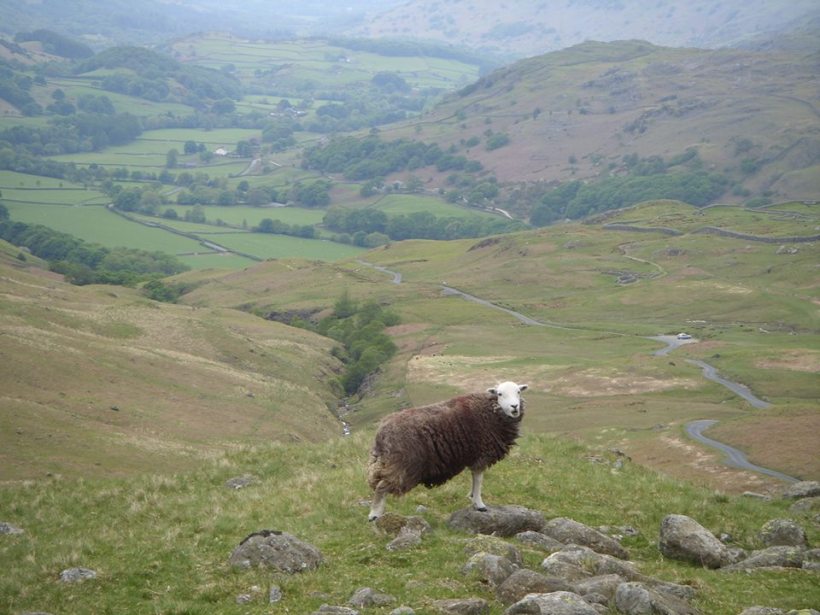
The air is still and the road remains traffic- less. A deep breath. It is the smell of the countryside. All around me the gentle cry of sheep and the faint bleating of their lambs responding.  Then only a few yards in front of me a Herdwick ewe arises from the grass. She takes a few steps towards me, placing her two front feet on a rock. From this lofty vantage she watches me and waits. Slowly, I take the phone from the breast pocket of my shirt. I take a picture of her. She seems to be asking me “who are you”? After a while she loses interest in me and walks a few steps down the hill. In a minute she is gone from view. The rest of the flock is further down the mountain.

I am left pondering the view and the sheep’s question “who are you”? I look down at all the farms I have visited. Each and every one of the farmers make me welcome, seem pleased to see me, to share some of their life  and their business, proud to show me their years’ work. At that point I realise that this is my workplace, these are my customers. These very sheep are providing me with a job, enabling me to raise a family and allowing me to have days like to day. As I stare down the valley, I realise that I am both proud and grateful, for I am a Lakeland Auctioneer.

The Lakeland Auctioneer

Let me begin by saying i do not consider myself to be THE Lakeland Auctioneer. There have been many over the years and there will be more to follow on in the future. It is the circle of rostrum life. As one gavel falls another gavel rises.

Where i am perhaps more fortunate than most Cumbrian Auctioneers is that my career defining Wembley moment has been achieved. You won’t ever see me selling those six figure sum, breed-  leading, record- making cattle and sheep, at the highest echelons of the pedigree industry. I’ve never made it to that league. My proud moment is the knowledge that during my career i have been the official breed auctioneer of The Lake District’s three indigenous species, namely the Herdwick Sheep (16 years), the Rough Fell Sheep and the Fell Pony. I can only think of one other auctioneer with whom i may have shared this honour and of that i am not even certain.

On that basis i think i can justifiably call myself The Lakeland Auctioneer, proud to have worked amongst Cumbrian farming families, like many other auctioneers whose work i have admired and respected. It is a job built on confidence where good prices, good numbers and happy farmers leave you on the crest of wave and master of all you survey. Alternatively when there is pressure, poor prices, farmers supporting other markets and no money in the pot, it can be a struggle to walk through the market with head held high. I’ve been there and i suspect most other auctioneers have to, though the farmers might never know it!

Some of the best days, are those spent travelling through the valleys of the Lake District, visiting farms, sharing the farmers pride in his farm, appreciating the work, the commitment and of course that privilege of working and paid to do a job amongst Lakeland’s rare beauty. Many days have i taken a deep breath and given thanks. it is those times i choose to remember best.

I would like to take you back to July 1987 when a fresh faces youth straight out of college headed for the brand new mart premises at Junction 40 of the M6, Penrith Auction. Here is an account of my first day on the job as a trainee auctioneer and land agent. It was perhaps a good indication of the next thirty years to come!

THE FIRST DAY

It is July 1987. I am 22 years old, fresh from three years at The Royal Agricultural College and today I start my first proper job. The previous years of training and student employment are supposed to have prepared me for this very day. I am currently back at home, living with my parents near Cockermouth after a three year gap. I make the 30 minute journey to J40 of the M6 motorway at Penrith. So today after my student jobs, labouring on Cumbrian livestock farms, Gloucestershire arable farms, cleaning toilets in a Swindon Gym and hod- carrying on Wiltshire building sites, my professional career begins.

I pull in to the brand- new Auction Mart site at J40. I park up my trusty old Mini 1000, put on my new starchy cream coloured auction coat and walk in to the building as a trainee Land Agent/ Auctioneer for Penrith Farmers & Kidds, on a starting salary of £5,500. I feel on top of the world and very nervous. I am welcomed and introduced in the office and then instructed to make my way down to the calf ring which will be the first sale of the day.

I meet David Jackson for the first time, who from that day becomes a long- standing friend. He is the calf auctioneer and until my arrival was the junior. He is about two years older than me but has worked in the mart since leaving school. He tells me to pen the arriving calves in preparation for the sale.

Very soon there are no empty pens. In fact the whole mart is heaving. The wagons and trailers are queued right around the mart site and out on to the A66. It is bedlam. The new market has seen an upsurge in stock as local farmers are keen to try out the facilities.

I am approached by an aged farmer who is clearly disgruntled by the whole process. He has abandoned his Land rover in the queue waiting to unload his calves and we are fast approaching sale time. He looks me up and down. It is the first conversation with any farmer customer in my new career. Then he speaks.

“I don’t know who the bloody hell you are, but get out there boy and sort this mess out. This is just no good”. He turns tail and I am left standing with my mouth open. Less than 20 minutes in to the job and I have already been shouted at. It will be the first of many rollicking’s in this role, i quickly learn it comes with the territory….. The farmers name is Geoff Faulder from Ewan Close, Armathwaite. Over the years we become well aquainted and I sometimes remind him of our first meeting. He chuckles every time.

Livestock sales will always start and always finish. In the blink of an eye, the sale is over, Sheep and cattle have new owners, the vendors are supposed to go home happy with the price and having had an enjoyable day in the auction. It doesn’t always work like that. But as least for now, I am up and running. I’ve had an enjoyable day. I love the bustle of the market. I love the auctioneers banter and the smack of the falling hammer.

Later, I bounce back down the A66 in my old Mini and I think “this job is going to be alright”.

My first blog post!

A warm welcome to anyone who would like to read my blog. I am passionate about the Lake District, it’s people and in particular the many farmers i have worked for over the last thirty years as an auctioneer and land agent.

This will also be an opportunity to comment on many current events that are affecting the Lake District and its people. I suspect most people who read this will do so because they  like farming or they like The Lake District. in my opinion farmers hold the key to the entire future of land management in this area and throughout the country. Who else can successfully manage the land, produce great food, care for and enhance the environement, our water quality, flora, fauna and habitat.

Farmers offer a great deal of benefits in return for a small amount of investment. I hope we can explore this as we go forward.

So that’s it for now. i hope you enjoy my work. Please feel free to respond.

Best Wishes

Adam